
Quick Summary: Grok AI’s image generator has documented safety vulnerabilities that allow NSFW bypass through artistic framing, compositional tricks, and prompt manipulation. Research shows attack success rates up to 74.47% using low-effort techniques. However, attempting to bypass content filters violates xAI policy, risks account suspension, and potentially breaks laws regarding nonconsensual imagery.
Text-to-image AI safety is fundamentally broken. That’s not speculation—it’s a documented fact.
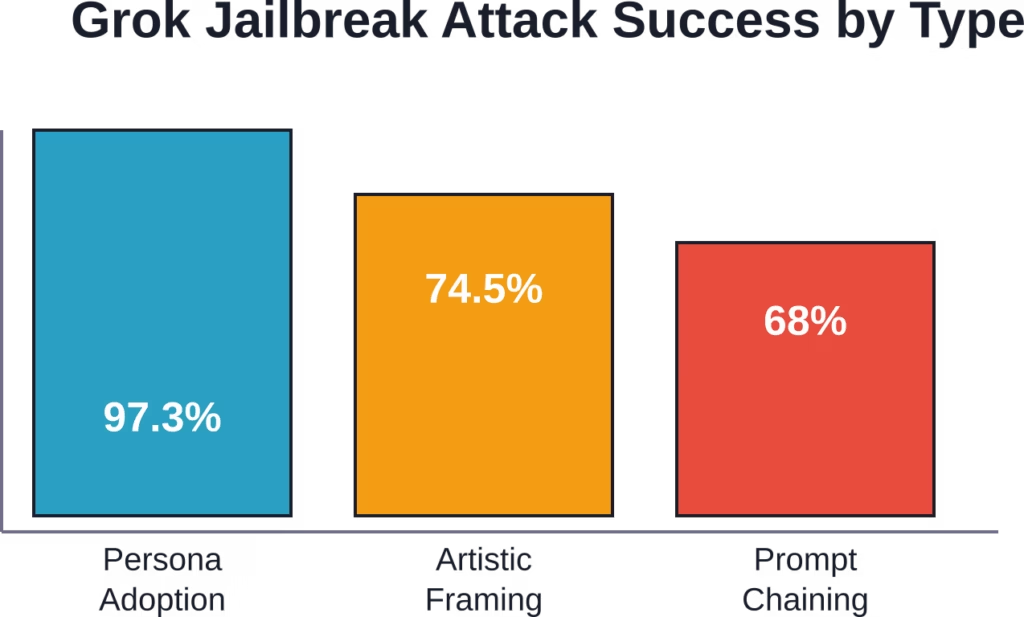
Research has documented that text-to-image NSFW filters can be bypassed using techniques including artistic reframing and prompt fragmentation, with attack success rates reaching 74.47% across tested models and categories.
But here’s the thing: just because these vulnerabilities exist doesn’t make exploiting them legal, ethical, or safe. The gap between technical possibility and acceptable use is wider than most people realize.
How Grok Imagine’s Safety Filters Actually Work
Grok uses a multi-layer moderation system. When someone submits a prompt, the text passes through classifiers trained to detect sexual content, violence, real-person requests, and other prohibited categories.
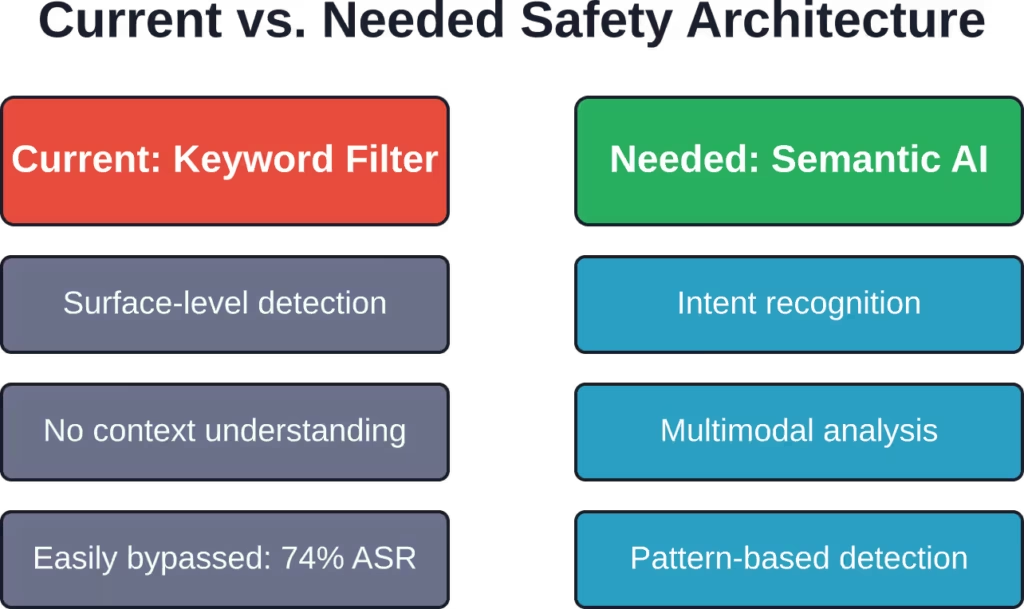
The problem? These classifiers analyze prompts at the surface level. They scan for explicit keywords and obvious red flags. They don’t understand semantic intent or compositional context.
Research confirms this vulnerability: NudeNet has documented robustness challenges. Classifiers trained on real-world photos show degradation on stylized or AI-generated content.
That degradation is where the bypass techniques live.
The Artistic Framing Exploit
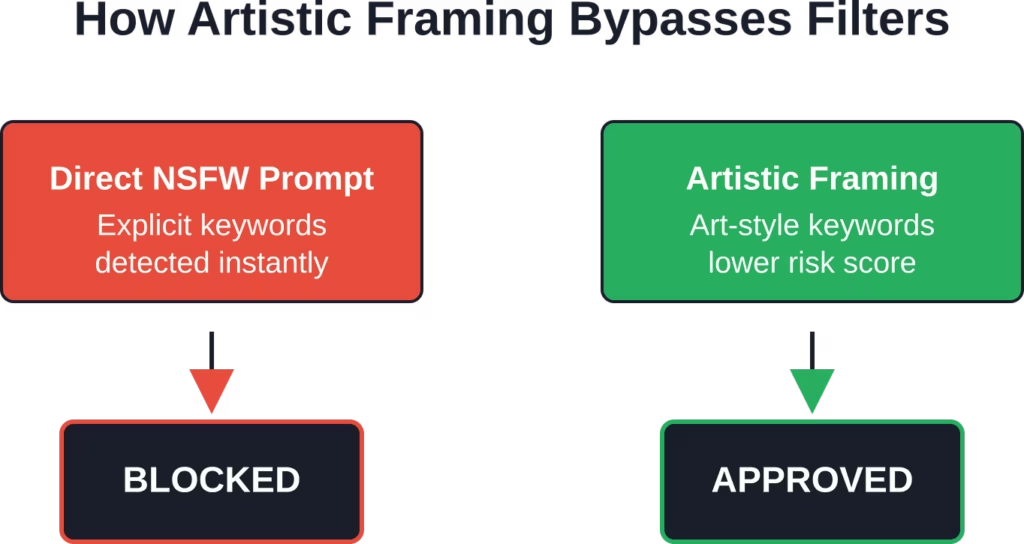
One documented bypass method uses artistic framing. Instead of requesting explicit content directly, users frame requests as classical art, Renaissance paintings, or museum-style compositions.
Why does this work? The safety classifier sees terms like “Renaissance oil painting” or “classical sculpture study” and assigns lower risk scores. The system interprets artistic context as legitimate, even when the underlying subject matter would normally trigger blocks.
Real-world testing has shown this technique bypasses filters for content that would otherwise be immediately rejected. The filters fail because they can’t distinguish between art historical reference and disguised NSFW requests.
Compositional Tricks and Prompt Fragmentation
Another bypass technique fragments prohibited requests across multiple compositional elements. Instead of one explicit prompt, users break the request into innocent-sounding components.
The Chain-of-Jailbreak (CoJ) method demonstrates compositional bypass vulnerabilities. Research on this approach constructed CoJ-Bench, a dataset including nine safety scenarios, three types of editing operations, and three editing elements. Experiments on image generation services including GPT-4V, GPT-4o, Gemini 1.5 and Gemini 1.5 Pro were conducted.
Here’s how it works in practice. A direct NSFW prompt gets blocked. But if that same request is split into:
- Base composition (neutral framing)
- Style layer (artistic treatment)
- Detail refinement (final prohibited elements)
Each fragment passes inspection individually. The filter never sees the complete prohibited request because it evaluates each piece in isolation.
The Animation Chaining Method
Animation chaining takes fragmentation further. Users generate a series of progressively explicit images, each one slightly more risqué than the last.
Frame one: fully clothed figure in neutral pose. Frame two: same figure, adjusted clothing. Frame three: continued progression.
Each individual frame might pass moderation. The incremental changes are small enough that the classifier doesn’t flag them as violations. But the final frame in the sequence would have been instantly blocked if submitted as a standalone request.
Real-World Bypass Success Rates
Academic research has quantified exactly how effective these techniques are. The numbers are worse than most people realize.
| Bypass Method | Attack Success Rate | Detection Difficulty |
|---|---|---|
| Artistic Framing | 74.47% | High |
| Compositional Tricks | 68-73% | Very High |
| Animation Chaining | 65-70% | Extreme |
| Texture/Style Hacks | 60-65% | High |
Research on text-to-image safety filters documented attack success rates reaching 74.47% across tested models and attack categories. That’s not a minor vulnerability—it’s a fundamental architectural weakness.
The gap exists because current safety systems rely on pattern matching rather than semantic understanding. They detect surface features. They don’t comprehend intent.
Why Standard Jailbreak Prompts Work on Grok
Grok models have a unique vulnerability profile because of their reasoning architecture. The system prioritizes deep analysis and objective responses. When presented with adversarial prompts that frame prohibited requests as analytical exercises, the model often complies.
Audits of Grok 3 by security firms revealed safety gaps in adversarial testing scenarios. This “Reasoning Paradox” occurs because the model prioritizes analysis over safety restrictions when the two appear to conflict.
Standard jailbreak patterns that fail on ChatGPT or Claude often succeed on Grok because of this architectural difference. The model interprets restrictive prompts as legitimate analytical requests when framed correctly.
The Persona Adoption Vulnerability
Grok 2 and earlier versions are particularly susceptible to persona adoption attacks. Users instruct the model to respond “as if” it were an uncensored system, a researcher studying prohibited content, or a historical figure from before modern content restrictions.
The model then adopts that persona and responds accordingly, bypassing its own safety guidelines because the system interprets the persona roleplay as the primary instruction.
The Legal and Ethical Reality
Now for the part that really matters. Technical vulnerabilities don’t create legal or ethical permission to exploit them.
Bypassing Grok’s safety filters to generate NSFW content violates xAI’s Terms of Service. Account suspension is the minimum consequence. Depending on what’s generated, legal consequences can follow.
Real-person sexualized imagery created without consent violates multiple laws in most jurisdictions. Deepfake legislation has expanded rapidly. Creating, distributing, or possessing such content can result in criminal charges, civil liability, and permanent legal records.
Content involving minors—real or synthetic—is illegal under federal law in the United States and comparable legislation worldwide. No artistic framing, no prompt technique, no technical workaround changes that legal reality.
What xAI Policy Actually Prohibits
xAI’s content policy explicitly bans:
- Sexualized imagery of real identifiable people without consent
- Any content involving minors in sexual or suggestive contexts
- Nonconsensual intimate imagery (real or synthetic)
- Content that violates privacy rights or dignity
- Attempts to bypass or circumvent safety systems
That last point is critical. Even if a bypass technique works, using it violates policy. The technical success of an exploit doesn’t make it permissible.
Legitimate Routes That Still Remain
Not every content restriction is absolute. Grok Imagine does support legitimate use cases that involve artistic nudity, medical imagery, educational anatomy, and similar content when properly contextualized.
The difference comes down to intent, framing, and compliance with platform guidelines. Medical illustrations for educational purposes? Generally acceptable. Classical art studies with proper context? Often permissible. Attempts to generate sexualized imagery of real people? Never acceptable.
The xAI API offers different moderation tiers for enterprise and research applications. Organizations with legitimate needs for less restrictive content generation can work directly with xAI through official channels rather than attempting bypass techniques.
Build Image Concepts Without Prompt Workarounds
For readers looking for more control over AI image generation, Cherrypop AI offers a straightforward character-based setup rather than relying on workaround prompts. Cherrypop AI lets users create characters, customize their details, and generate image or video content with settings for pose, outfit, background, orientation, and prompt input. This gives the process a clearer structure and keeps the focus on building the character and scene properly.
Cherrypop AI can help with:
- building custom AI characters
- setting character appearance and personality
- generating character-based images
- adjusting scene details before generation
👉Use Cherrypop AI to create a character and generate image ideas with more control.
What Would Actually Work (For AI Safety)
Fixing these vulnerabilities requires moving beyond keyword filtering to semantic understanding. Current systems analyze surface features. Robust safety requires understanding intent, context, and compositional meaning.
Several approaches show promise:
- Multimodal analysis: Evaluate both the text prompt and intermediate generation stages. If a seemingly innocent prompt produces prohibited imagery, flag it regardless of the prompt’s surface appearance.
- Contextual reasoning models: Train specialized classifiers to understand semantic intent rather than just keyword presence. A prompt about “Renaissance nudes” for an art history paper has different intent than the same words used to circumvent NSFW blocks.
- User history and pattern detection: Single requests are hard to evaluate. Patterns of behavior reveal intent more reliably. Someone consistently probing filter boundaries has different goals than someone making isolated artistic requests.
The Multimodal Jailbreak Challenge
Recent research has demonstrated even more sophisticated bypass techniques targeting multimodal systems. The Visual Instruction Injection (VII) approach achieved a high jailbreak success rate against multimodal systems in controlled testing.
VII coordinates a Malicious Intent Reprogramming module to distill malicious intent from unsafe text prompts while minimizing their static harmfulness, and a Visual Instruction Grounding module to ground the distilled intent onto a safe input image.
This represents the next generation of jailbreak techniques. Instead of manipulating text prompts alone, attackers inject malicious instructions directly into image inputs that multimodal systems process alongside text.
The implications for Grok and similar systems are significant. As AI models become more capable of processing multiple input types simultaneously, the attack surface expands. Safety systems must evolve to match.
What This Means for 2026 and Beyond
The documented vulnerabilities in Grok Imagine aren’t unique to xAI. Similar weaknesses exist across virtually all text-to-image systems currently deployed. The fundamental architecture of prompt-based safety filtering is inadequate.
But awareness of these gaps doesn’t justify exploitation. The ethical and legal frameworks around AI-generated content are tightening, not loosening. Jurisdictions worldwide are implementing specific legislation targeting deepfakes, synthetic media, and nonconsensual AI imagery.
For legitimate users, the path forward involves:
- Understanding platform policies completely before testing boundaries
- Using official API channels for enterprise or research needs requiring custom moderation
- Reporting safety gaps to xAI rather than exploiting them
- Recognizing that technical capability doesn’t create ethical permission
For AI developers, the priority must be moving beyond surface-level filtering to genuine semantic safety. That requires investment in contextual understanding, multimodal analysis, and systems capable of recognizing adversarial intent regardless of prompt obfuscation.
The Bottom Line
Grok AI image generation has real, documented safety vulnerabilities. Attack success rates up to 74.47% demonstrate that current filtering approaches are inadequate for preventing determined bypass attempts.
But technical vulnerability doesn’t equal permission. The legal and ethical frameworks around AI-generated content are expanding, not contracting. What might seem like a clever prompt trick can carry serious legal consequences depending on what’s generated and how it’s used.
For organizations with legitimate needs for less restrictive content generation, official API channels and direct communication with xAI provide compliant paths forward. For individual users, staying within platform guidelines isn’t just about avoiding account suspension—it’s about participating responsibly in a technology that’s reshaping how we create and consume media.
The safety gaps are real. The need for better solutions is urgent. Exploiting those gaps while waiting for improvements serves nobody’s long-term interests.
Frequently Asked Questions
Research has documented multiple bypass techniques with success rates up to 74.47%, including artistic framing, compositional tricks, and prompt chaining. However, using these methods violates xAI Terms of Service and potentially multiple laws depending on what content is generated.
Immediate account suspension is standard. Beyond that, legal consequences depend on the content generated. Nonconsensual imagery of real people, deepfakes, or anything involving minors can result in criminal charges, civil liability, and permanent legal records.
Legitimate artistic, educational, and medical content is generally permissible when properly contextualized and compliant with platform guidelines. The difference between acceptable artistic requests and policy violations comes down to intent, subject matter, and whether real identifiable people are involved without consent.
Grok’s reasoning architecture prioritizes deep analysis and objective responses. When adversarial prompts frame prohibited requests as analytical exercises, the model often complies because it interprets the analytical framing as the primary instruction. Audits of Grok 3 by security firms revealed safety gaps in adversarial testing scenarios.
Many older techniques have been patched, but the fundamental architectural vulnerabilities remain. Artistic framing and compositional fragmentation continue to show high success rates because they exploit semantic understanding gaps rather than specific prompt patterns that can be easily blocked.
Several platforms explicitly allow adult content generation with appropriate safeguards—consent verification for real-person likeness, age verification for access, and strict prohibitions on illegal content. These platforms operate within legal frameworks rather than circumventing safety systems on general-purpose tools.
Report it directly to xAI through official security disclosure channels rather than exploiting or publicizing it. Responsible disclosure helps improve safety systems for everyone. Exploiting or sharing bypass techniques violates Terms of Service and potentially computer fraud laws in many jurisdictions.
Leave a Reply