
Quick Summary: Yes, AI can generate pornographic content using technologies like GANs, diffusion models, and text-to-image generators. Major platforms like OpenAI are exploring ‘responsible’ NSFW content policies, while tools like Stable Diffusion and specialized AI porn generators are already widely used. However, this capability raises serious ethical concerns around nonconsensual deepfakes, exploitation, and the flooding of social media platforms with AI-generated explicit material.
The question isn’t really whether AI can make porn anymore. It’s how easily it can do it, who’s doing it, and what that means for everyone online.
Generative AI has reached a point where creating explicit images and videos requires nothing more than a text prompt and a few clicks. The technology is accessible. The tools are proliferating. And the consequences are already playing out across social media platforms, in courtrooms, and in the lives of people who never consented to being depicted this way.
The Technology Behind AI-Generated Pornography
AI pornography relies primarily on generative adversarial networks (GANs) and diffusion models—the same core technologies powering legitimate image synthesis applications.
According to research published on arXiv, GANs for text-to-image synthesis have evolved significantly since their introduction in 2016. These systems learn to generate realistic images by training on massive datasets, then producing new content based on text descriptions.
But here’s the thing—these technologies don’t distinguish between creating a landscape and creating explicit content. The underlying architecture works the same way.
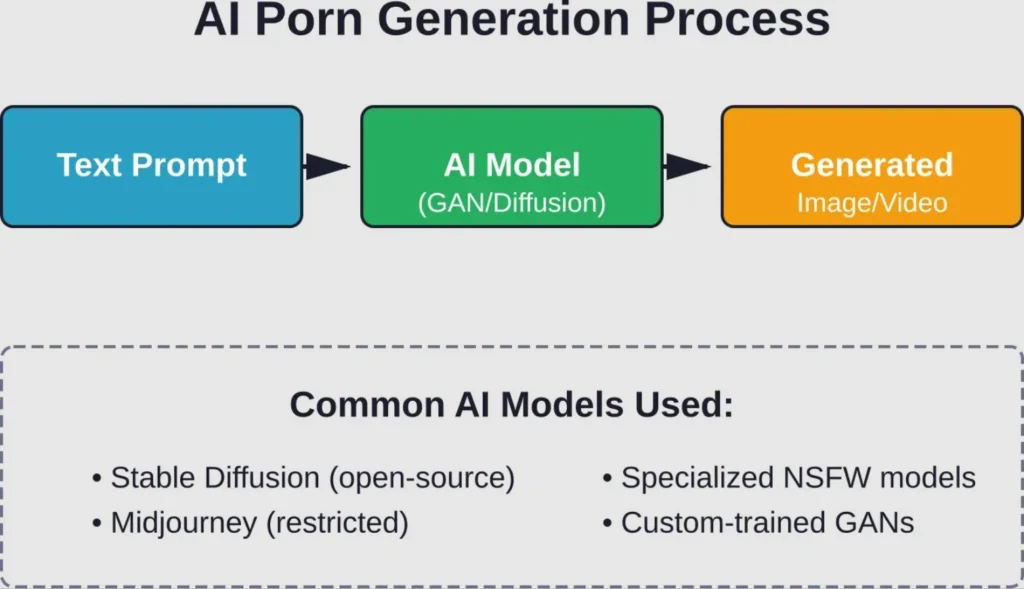
Open-source models like Stable Diffusion have been modified by users to remove safety filters, creating unrestricted versions capable of producing any content imaginable. These modified models circulate freely online.
According to NIST research on synthetic content, mitigating risks from these technologies remains a priority challenge. The agency published guidelines in 2024 addressing digital content transparency—but enforcement across decentralized tools is nearly impossible.

Try AI Girlfriend Chats Without the Setup
Cherrypop.ai makes it easy to test AI conversations. Everything is already built in, so you can focus on interacting instead of setting things up.
You can move between characters, adjust how they act, and see how each conversation changes.
Looking for Something Quick to Try?
With Cherrypop.ai, you can:
- jump into chats right away
- experiment with different personalities
- see how interactions evolve
👉 Join free on Cherrypop.ai to try it yourself
Major Platforms and Their Shifting Policies
OpenAI, the maker of ChatGPT, in late 2025, updated its usage policies and model system prompts to permit the generation of age-restricted NSFW content and erotica for authenticated users 18+, provided the content does not involve real individuals or non-consensual depictions.
This marked a significant shift. For years, major AI companies maintained strict prohibitions against sexual content. Now, some are reconsidering.
The rationale? If people are going to create this content anyway using unregulated tools, perhaps controlled access through major platforms with safety guardrails might reduce harm.
But that’s theory. Reality looks different.
In January 2025, AI-generated pornography flooded the social media site X, owned by Elon Musk. The platform’s AI chatbot, Grok, was used to generate explicit images of real people—celebrities, public figures, and ordinary users—without their consent.
According to the FTC, which launched an inquiry into AI chatbots in September 2025, the agency issued 6(b) orders to seven companies operating consumer-facing AI chatbots to seek information on their operations.
| Platform | Current NSFW Policy (2026) | Enforcement |
|---|---|---|
| OpenAI (ChatGPT/DALL-E) | Age restricted erotica | Active content filtering |
| X/Grok | Minimal restrictions | Weak enforcement |
| Midjourney | Permitted in ‘Private Mode’ for Pro/Mega subscribers | Strong moderation |
| Stable Diffusion | Open-source (no central policy) | User-dependent |
The Nightmare of Nonconsensual Deepfakes
Here’s where this gets dark.
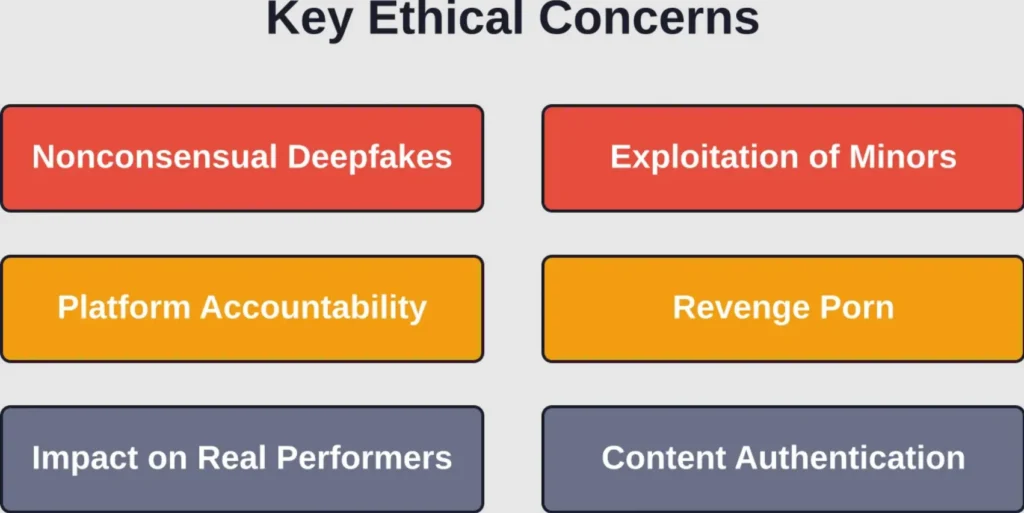
The Washington Post reported that AI porn is “easy to make now” and “for women, that’s a nightmare.” The article highlighted how content creators, streamers, and ordinary people have discovered explicit AI-generated images of themselves online—images they never posed for and never consented to.
According to FTC consumer guidance published in December 2025 on nonconsensual distribution of intimate images, this practice is recognized as a serious violation. The agency provides resources for victims seeking recourse.
Real talk: the technology doesn’t require nude photos to start with. A fully clothed image from social media can be transformed into explicit content. Face-swapping technology makes it trivially easy to place anyone’s likeness onto pornographic material.
Community discussions on platforms like Reddit have touched on the technical process of AI porn generation, with some users describing their experiences.
Legal Consequences and State Responses
Criminal consequences for AI-generated pornography have been discussed in legislative approaches, with Texas mentioned in reporting on state responses to synthetic content. Other states are following suit.
According to Brookings Institution research published in August 2025 on state AI approaches, legislation varies widely. Some states focus on criminal penalties, others on civil remedies, and many are still drafting their first bills addressing synthetic content.
But legislation is racing to catch up with technology that’s already everywhere.
The Commercial AI Porn Industry
Wikipedia’s entry on generative AI pornography notes that many sites feature extensive image libraries and continuous content feeds, combining personalization with discovery. These platforms attract users seeking niche experiences that traditional pornography doesn’t provide.
The technology enables hyper-personalization. Users can specify exact physical characteristics, scenarios, and settings. The AI generates custom content on demand.
This raises questions about creativity versus exploitation, fantasy versus harm, and where ethical boundaries exist in entirely synthetic content.
Can This Be Controlled?
The short answer? Not easily.
NIST’s 2024 report on reducing risks from synthetic content examines existing standards, tools, and methods for digital content transparency. Watermarking, content provenance tracking, and detection algorithms show promise—but none are foolproof.
Open-source models can’t be recalled or updated centrally. Once released, they exist forever across countless servers and hard drives worldwide. Modified versions without safety filters proliferate faster than platforms can block them.
Detection is a cat-and-mouse game. As detection tools improve, generation tools evolve to evade them.
Frequently Asked Questions
Yes, modern AI models using GANs and diffusion technology can create highly realistic explicit images and videos that are often indistinguishable from real photographs. The quality has improved dramatically since 2024.
Legality depends on jurisdiction and content specifics. Creating synthetic pornography of real people without consent is illegal in many states, including Texas. Content involving minors—even entirely synthetic—is illegal federally. Laws vary by state and are rapidly evolving.
Modified versions of Stable Diffusion are most common, along with specialized NSFW models trained specifically for explicit content. Some users modify open-source models to remove safety filters. Grok on X has also been used to create explicit content.
Detection is increasingly difficult. Common tells include unrealistic hands, inconsistent lighting, strange anatomical proportions, and background artifacts—but these are disappearing as models improve. Specialized detection tools exist but aren’t foolproof.
According to the FTC’s December 2025 guidance on nonconsensual intimate images, victims should document the content, report it to the hosting platform, consider contacting law enforcement, and explore civil remedies. Many states now have specific laws addressing this.
The impact is debated. Some argue it could reduce exploitation and trafficking; others worry it devalues human performers’ work and creates unrealistic expectations. The long-term economic and social effects remain uncertain.
Looking Forward
AI can absolutely make porn. It’s doing it right now, at massive scale, with improving quality.
The technology itself is neutral—it’s a tool. But the applications and consequences are anything but neutral. Nonconsensual deepfakes destroy reputations and violate dignity. Platforms struggle to balance free expression against harm prevention. Lawmakers can’t keep pace with technological evolution.
What happens next depends on how society chooses to respond. Stronger legal frameworks, better detection technology, platform accountability, and public awareness all play roles.
But one thing’s certain: pretending this technology doesn’t exist or hoping it goes away isn’t a strategy. The capabilities are here. The question is what we do about them.
If you’ve been affected by nonconsensual AI-generated content, consult the FTC’s resources on intimate image distribution and explore legal options in your jurisdiction. Documentation and swift action matter.
Leave a Reply