
Quick Summary: AI-generated pornography legality depends on the type of content and jurisdiction. Federal law and most states ban AI-generated child sexual abuse material (CSAM) and non-consensual deepfake pornography of adults. Consensual adult AI porn remains legal in many states, though this is rapidly changing as lawmakers address enforcement gaps.
In January 2024, explicit AI-generated images of Taylor Swift flooded social media. The images racked up hundreds of millions of views before platforms could act.
That single viral moment forced a national conversation lawmakers had been avoiding. The question became unavoidable: Is AI-generated pornography legal?
The answer isn’t simple. It depends on what kind of AI porn, who’s depicted, whether consent was given, and which state you’re in.
Here’s where things stand in 2026.
Understanding the Types of AI-Generated Porn
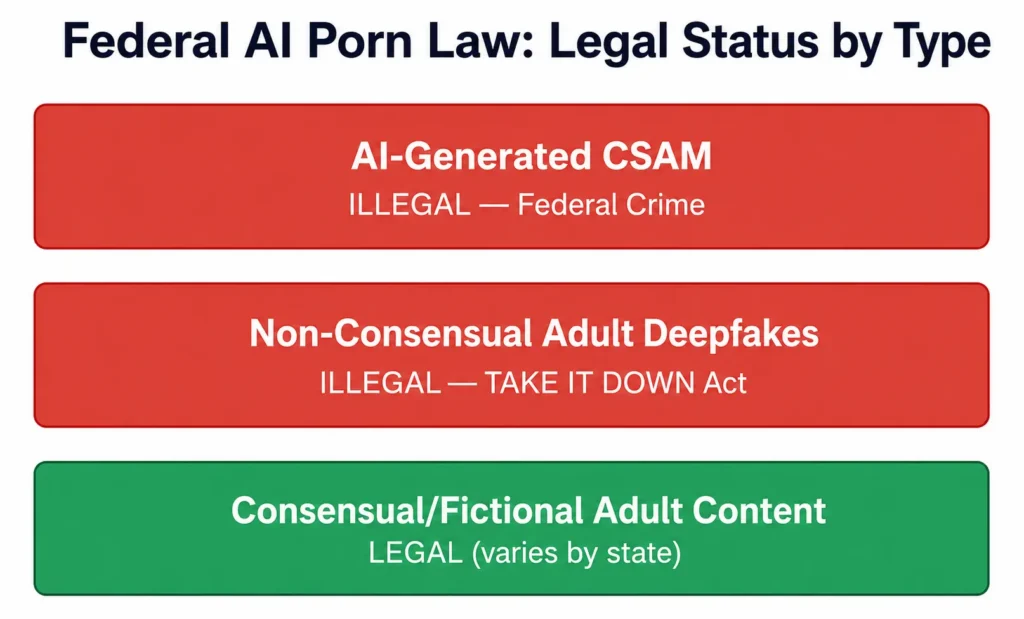
Not all AI pornography falls into the same legal category. Courts and legislators distinguish between three main types:
- AI-generated child sexual abuse material (CSAM) depicts minors in sexual situations, whether the child is real or entirely fictional. This includes images that appear to show real children or are computer-generated but realistic.
- Non-consensual deepfake pornography involves placing an identifiable adult’s face or likeness onto sexually explicit content without permission. These are the revenge-style deepfakes that sparked most state legislation.
- Consensual or fictional adult content includes AI-generated pornography that doesn’t depict real, identifiable people or was created with explicit consent from everyone depicted.
- The legal status of each category varies dramatically.

Try AI Girlfriend on Cherrypop.ai
Cherrypop.ai lets you chat with AI companions or create your own. You can pick a character, tweak a few traits, and start talking right away.
It’s a simple way to see how different personalities respond and how conversations change the more you interact.
Want to See How It Works?
With Cherrypop.ai, you can:
- chat with AI girlfriends
- create and adjust characters
- explore different conversation styles
👉 Join free on Cherrypop.ai to try it yourself
Federal Law: What’s Illegal Nationwide
Federal law establishes baseline prohibitions that apply in every state. Two categories of AI porn face federal criminal penalties.
AI-Generated CSAM Is Federally Illegal
According to the U.S. Department of Justice, creating, possessing, or distributing AI-generated child sexual abuse material is a federal crime. In February 2026, a federal jury convicted a repeat sex offender of receiving and possessing AI-generated CSAM alongside other child exploitation offenses.
A Charlotte man received a 6½-year sentence for possessing AI-generated CSAM. Another case involved a man arrested for producing, distributing, and possessing AI-generated child abuse material.
The key point: It doesn’t matter if the child depicted is real or entirely computer-generated. Federal prosecutors treat AI-generated CSAM as seriously as photographs of real abuse.
The TAKE IT DOWN Act: Non-Consensual Deepfakes
The TAKE IT DOWN Act made non-consensual deepfake pornography of adults a federal crime. Threatening to share or actually sharing deepfake porn depicting an identifiable person without consent now carries federal penalties.
This law closed a significant gap. Before its passage, many deepfake victims had no federal recourse unless they could prove additional crimes like stalking or harassment.
A Columbus man pleaded guilty to cyberstalking exes and creating AI-generated explicit images, demonstrating how federal prosecutors now combine deepfake charges with related offenses.
State Laws: A Patchwork of Regulations
State laws vary dramatically. Some states have comprehensive AI porn legislation; others rely on older revenge porn statutes that don’t explicitly address AI-generated content.
AI-Generated CSAM at the State Level
Forty-five states have enacted laws criminalizing AI-generated or computer-edited CSAM, according to current legal tracking. These state laws often carry harsher penalties than federal statutes and close enforcement gaps.
The remaining states without explicit AI CSAM laws still prosecute these cases under existing child pornography statutes, though legal challenges occasionally arise over whether purely fictional AI-generated images meet statutory definitions.
Non-Consensual Deepfake Laws by State
As of January 2026, South Carolina became the 50th state to enact revenge porn legislation, according to Harvard Gazette reporting. But here’s the catch: not all revenge porn laws explicitly cover AI-generated or deepfake content.
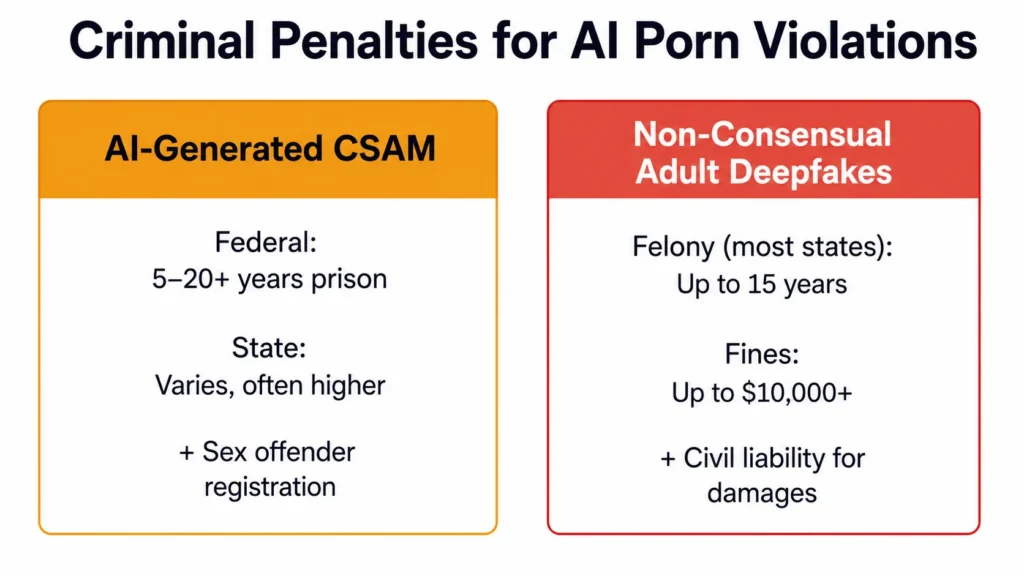
Many states have updated their statutes to address the AI wrinkle. Tennessee, for example, made sharing deepfakes without permission a felony. Perpetrators can serve up to 15 years in prison and pay a maximum of $10,000 in fines.
Other states lag behind. Their revenge porn laws require the image to be an actual photograph or video, leaving AI-generated deepfakes in a gray zone.
| Content Type | Federal Law | Most States |
|---|---|---|
| AI-generated CSAM (fictional or real child) | Illegal | Illegal (45 states) |
| Non-consensual AI deepfake porn (adult) | Illegal (TAKE IT DOWN Act) | Illegal in most states |
| Consensual adult AI porn | Legal | Legal (with exceptions) |
The Consent Question: Why It Matters Legally
Consent sits at the core of most AI porn legislation. Federal and state governments have largely concluded that creating sexual imagery of someone without permission violates their rights, even if the imagery is computer-generated.
But consent gets complicated with AI. What if someone uses a celebrity’s publicly available photos? What if the AI-generated face only somewhat resembles a real person? What if the subject gave consent initially but later withdrew it?
According to Harvard Gazette analysis published in January 2026, what’s lawful and who’s responsible remains unclear when explicit images look real but are digitally generated. The U.K. has threatened to ban platforms like X and Grok over inadequate AI content moderation.
Courts are still working through these edge cases. Generally speaking, if a reasonable person could identify the subject of AI porn, and that subject didn’t consent, it’s likely illegal.
Platform Responsibilities: What Tech Companies Must Do Now
The legal landscape increasingly holds platforms accountable for hosting AI-generated pornography. Major social media companies now face pressure from regulators worldwide.
According to available reporting, standards organizations are developing watermarking approaches for video identification. Standards like watermarking assist in collecting data like the creator’s identity, which becomes especially important as videos contribute to 80% of internet traffic.
On Christmas Eve 2025, Elon Musk announced that Grok would include image and video editing features. Numerous X users asked Grok to edit photos of real women and even children by stripping them down to bikinis (or worse), and Grok often complied. The resulting torrent of sexualized imagery faced investigation by regulators worldwide.
Platforms that fail to quickly remove non-consensual AI porn after notification increasingly face legal liability. The TAKE IT DOWN Act specifically requires platforms to establish removal mechanisms.
Penalties: What Offenders Face
Penalties for illegal AI porn vary widely based on the offense and jurisdiction.
For AI-generated CSAM, federal sentences typically range from several years to decades. As noted earlier, one Charlotte defendant received 6½ years, while a repeat offender convicted of multiple child exploitation offenses including AI-generated material faced significantly longer sentencing.
For non-consensual deepfake pornography of adults, state penalties differ substantially. Tennessee’s 15-year maximum represents the high end. Other states impose misdemeanor penalties for first offenses, with felony charges for repeat violations or cases involving distribution.
Civil liability adds another layer. Victims can sue creators and distributors of non-consensual deepfakes for damages, often recovering substantial amounts for emotional distress, reputational harm, and related losses.
The First Amendment Question
Academic and legal debates continue around whether banning certain AI-generated pornography violates First Amendment free speech protections.
Academic sources examine constitutional justifications for criminalizing AI-generated child pornography. The core legal question: Can the government ban purely fictional imagery that doesn’t involve actual victims?
Courts have generally upheld AI CSAM bans under the reasoning that such material fuels demand for real abuse and is used to groom victims. The Supreme Court has historically allowed restrictions on obscenity and child pornography as exceptions to First Amendment protections.
For non-consensual deepfakes, the legal theory differs. These laws rest on privacy rights and protection from reputational harm rather than obscenity doctrine. Courts have been receptive to this reasoning, viewing non-consensual sexual imagery as closer to defamation or harassment than protected speech.
But wait. Consensual adult AI porn—featuring entirely fictional characters or created with permission—likely enjoys First Amendment protection. That’s why most legislation carefully targets only non-consensual content.
What About Possession Without Distribution?
Community discussions on platforms like Reddit frequently ask whether possessing AI-generated explicit images without sharing them is illegal.
The answer depends on content type. For AI-generated CSAM, possession alone is a federal crime and illegal in most states. Distribution isn’t required for prosecution.
For non-consensual adult deepfakes, most state laws focus on creation and distribution rather than mere possession. Possessing a deepfake someone else created, without sharing it, falls into a legal gray area in many jurisdictions. That said, possession can still trigger civil liability if discovered, and prosecutors may pursue charges under related statutes.
Real talk: Possession of any illegal pornographic content creates legal risk, even if distribution wasn’t intended.
What’s Coming Next: The Legal Future
AI porn legislation is evolving rapidly. Several trends are emerging as of 2026:
- Broader state adoption: States without explicit AI porn laws are introducing legislation. Expect near-universal coverage within two years.
- Platform liability expansion: Lawmakers increasingly favor holding platforms strictly liable for hosting non-consensual content, shifting enforcement burden from prosecutors to tech companies.
- International coordination: The U.K.’s aggressive stance toward platforms like X signals growing international pressure for consistent content moderation standards.
- Detection technology mandates: Some proposed legislation would require AI porn platforms to implement detection systems that flag potentially non-consensual content before publication.
The legal framework will likely stabilize as courts resolve pending cases and establish precedents around consent, identifiability, and platform responsibilities.
Frequently Asked Questions
Yes, in most cases. Creating non-consensual deepfake pornography of identifiable people—including celebrities—violates federal law under the TAKE IT DOWN Act and is illegal in most states. Celebrity status doesn’t eliminate the consent requirement.
Yes. AI-generated adult pornography featuring entirely fictional characters or created with explicit consent from all depicted individuals remains legal under federal law and in most states. The key factors are consent and whether real, identifiable people appear without permission.
Victims should document the content, report it to the hosting platform immediately under TAKE IT DOWN Act provisions, file a report with local law enforcement, and consult an attorney about civil claims. Many states provide specific legal remedies for deepfake victims.
The generators themselves aren’t illegal, but using them to create non-consensual content or CSAM is criminal. Most legitimate AI generation platforms implement safeguards against creating illegal content, though enforcement varies.
Prosecutors use various methods including facial recognition technology, witness testimony from people who recognize the subject, digital forensics showing source images were used, and expert analysis of distinctive features. The standard is whether a reasonable person could identify the subject.
No. Watermarking helps platforms identify and remove content and can assist in tracking creators, but it doesn’t make non-consensual content legal. Watermarking serves enforcement purposes rather than providing legal safe harbor.
This remains legally unsettled. Generally speaking, consent given at the time of creation likely protects the creator from criminal liability, but victims may pursue civil remedies if circumstances change. Best practice is obtaining written, explicit consent that addresses future use.
Bottom Line
AI pornography exists in a rapidly evolving legal landscape. Federal law clearly bans AI-generated CSAM and non-consensual deepfakes of adults. Most states have followed suit with their own prohibitions.
Consensual adult AI porn remains legal in many jurisdictions, though this represents the exception rather than the rule. The legal trend strongly favors protecting individuals from non-consensual sexual imagery, whether photographed or computer-generated.
Penalties range from substantial federal prison sentences for CSAM to felony charges and civil liability for deepfakes. Platforms face increasing pressure to police AI-generated content.
The takeaway: consent is everything. AI pornography created without the permission of identifiable subjects is illegal in most contexts and carries serious consequences. Before creating, possessing, or sharing AI-generated sexual content, understand the specific laws in your jurisdiction and ensure all depicted individuals have provided explicit consent.
Leave a Reply