
Quick Summary: Yes, AI porn is very real and rapidly growing—platforms like Civitai now serve 27 million monthly visits. Generative AI creates entirely synthetic adult content from text prompts, no real actors required, while deepfake technology can place anyone’s face into explicit videos without consent. This raises serious ethical, legal, and privacy concerns that society is still struggling to address.
If you’ve been wondering whether AI porn is actually a thing, the short answer is yes—and it’s bigger than most people realize.
Artificial intelligence has quietly revolutionized the adult entertainment industry. Platforms dedicated to AI-generated explicit content now attract millions of users monthly. Technology that once seemed like science fiction—creating photorealistic pornographic images from simple text descriptions—is now accessible to anyone with an internet connection.
But here’s where it gets complicated. This isn’t just about new ways to create adult content. The same technology enables deepfakes that can place anyone’s face into explicit videos without their knowledge or consent. Research shows that 98% of all deepfake videos ever created are pornographic, and the technology continues improving at an alarming rate.
So what exactly is AI porn? How does it work? And what does this mean for privacy, consent, and the future of adult entertainment? Let’s break down everything you need to know.
What Exactly Is AI Porn?
AI porn refers to sexually explicit content created using artificial intelligence technologies, primarily through two methods: fully synthetic generation and deepfakes.
Generative AI pornography uses machine learning models to create entirely artificial images and videos from scratch. Think of it like this: you type a text description of what you want to see, and sophisticated AI models—trained on massive datasets—generate photorealistic explicit content that matches your prompt. No cameras, no actors, no physical production required.
The most common technology behind this is Stable Diffusion and similar generative adversarial networks (GANs). These systems have learned patterns from millions of images and can now synthesize new content that looks convincingly real.
Deepfake pornography takes a different approach. This technology maps one person’s face onto another person’s body in existing videos. The AI analyzes facial features, expressions, and movements, then seamlessly replaces the original face with the target face. The results can be disturbingly realistic.
According to research, 78% of total papers published on deepfakes have appeared in the last two years. This explosion of research reflects how rapidly the technology has advanced—and how seriously researchers are taking the implications.
The Scale of AI Porn in 2026
The numbers tell a striking story about how mainstream this technology has become.
Civitai, the largest AI-centric content platform in the United States, recorded roughly 26.97 million visits, with traffic experiencing substantial month-over-month increases. Founded in 2022, the platform has raised over US$5 million in venture funding, including investment from major players like Andreessen Horowitz.
But what are people actually using these platforms for?
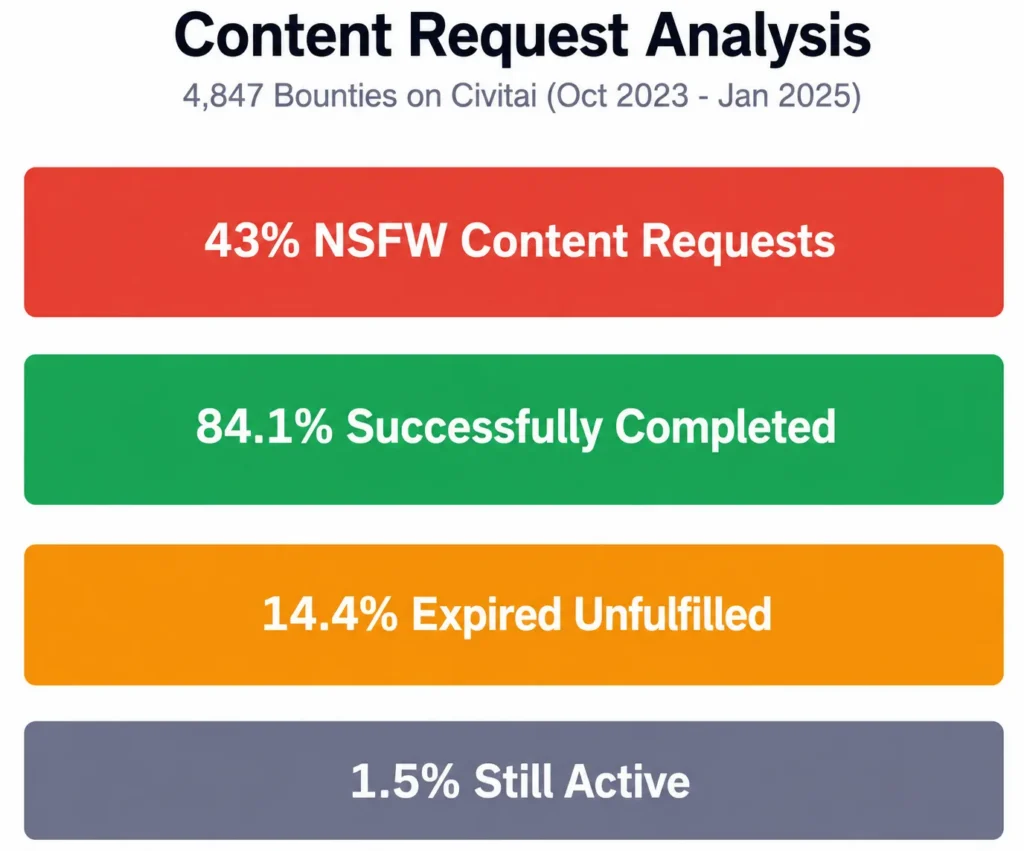
Research analyzing bounties on Civitai reveals the explicit nature of demand. Requests for “Not Safe For Work” content are widespread and have increased steadily over time, now comprising a majority of all bounties.
Research on bounty platforms shows completion rates for various types of content requests vary. This high fulfillment rate demonstrates a robust marketplace where supply readily meets demand.

Chat With AI Girlfriend on Cherrypop.ai
Cherrypop.ai is all about quick, simple AI conversations. You can pick a companion, adjust a few details, and start chatting right away.
It’s an easy way to see how different personalities respond and how conversations change over time.
Want to Try It Out?
With Cherrypop.ai, you can:
- chat with AI companions
- explore different personalities
- see how conversations develop
👉 Join free on Cherrypop.ai to try it yourself
How AI Porn Actually Works
Understanding the technology helps clarify both the capabilities and the risks.
Text-to-Image Generation
Most AI porn platforms use text-to-image models like Stable Diffusion, which have been fine-tuned on adult content. Users enter detailed text prompts describing what they want—physical characteristics, scenarios, settings, poses—and the AI generates corresponding images within seconds.
These models work through a process called diffusion, starting with random noise and gradually refining it based on learned patterns until it matches the text description. The models have been trained on enormous datasets containing billions of images, allowing them to understand and replicate complex visual concepts.
Many platforms offer extensive customization: body types, ethnicities, specific scenarios, artistic styles, and camera angles. Some sites feature continuous content feeds with thousands of AI-generated images, combining personalization with discovery features that enhance user engagement.
Deepfake Technology
Deepfakes use a different approach called face-swapping. The AI needs sample images or video of the target face—often just social media photos are sufficient. It then analyzes facial landmarks, skin texture, lighting, and expressions.
When applied to video, the AI tracks the original face frame-by-frame and replaces it with the synthesized target face, adjusting for angle, lighting, and movement to maintain realism. Modern deepfake tools can even match voice patterns, creating fully believable fake videos.
The barrier to entry has dropped dramatically. Tools that once required technical expertise and powerful hardware can now run on consumer laptops or even smartphones.
The Deepfake Problem: Non-Consensual Content
Here’s where AI porn crosses from controversial to genuinely harmful.
Non-consensual intimate imagery (NCII)—explicit content created or shared without someone’s permission—has exploded with AI technology. Research findings indicate that the vast majority of deepfakes are pornographic.
Celebrities were the first major targets, but the problem has spread far beyond famous faces. Regular people—colleagues, classmates, ex-partners, public figures—increasingly find themselves victims of deepfake pornography created from their social media photos.
Stanford research on child safety highlights particularly disturbing trends: tools enabling teenagers to create deepfake nude images of their peers are compromising child safety at scale. The ease of access means minors can weaponize this technology against each other, often with devastating psychological consequences for victims.
The technology enables harassment, revenge porn, and reputational damage on an unprecedented scale. Because the content looks real, victims face the impossible task of proving it’s fake—and even when proven false, the damage to reputation and mental health persists.
The financial stakes are high too. Deepfakes have been documented in fraudulent schemes, demonstrating how the technology extends beyond pornography into financial crime.
Ethical Concerns Around AI-Generated Adult Content
Even fully synthetic AI porn—content not depicting any real person—raises thorny ethical questions.
Consent and Likeness
When AI generates content resembling real people without their permission, consent becomes murky. Even if the AI didn’t specifically target someone, the result might closely resemble them. Who owns the rights to an AI-generated face that looks identical to yours by chance—or by design?
Exploitation Without Victims?
AI can generate content depicting scenarios that would be illegal or unethical to produce with real people. This creates philosophical dilemmas: if no real person is harmed in creation, is the content still harmful? Many argue yes, because it normalizes harmful scenarios and may influence real-world behavior.
Impact on Performers
The adult entertainment industry employs thousands of performers who earn their living creating content. AI-generated alternatives threaten these livelihoods. At the same time, some argue the technology could reduce exploitation in an industry with documented labor issues.
Psychological and Social Effects
Unlimited access to highly personalized AI pornography raises questions about addiction, relationship dynamics, and sexual development—especially for younger users. The potential for “unprecedented interactivity and realism” creates engagement patterns that traditional pornography couldn’t match.
Research interest has surged precisely because these questions remain unresolved. The technology has outpaced our ethical frameworks.
What Does the Law Say?
Legal frameworks are struggling to keep pace with AI porn technology, creating a patchwork of protections that vary dramatically by jurisdiction.
Non-Consensual Deepfakes
Many jurisdictions now recognize non-consensual deepfake pornography as illegal, but enforcement remains challenging.
The problem? Cross-border enforcement is nearly impossible. Platforms hosting AI porn often operate from jurisdictions with minimal regulation, making legal action difficult for victims.
Fully Synthetic Content
When AI generates content not depicting any real person, the legal situation becomes murkier. Generally, creating fully synthetic adult content isn’t illegal in most jurisdictions—provided it doesn’t depict minors or violate obscenity laws.
But defining what constitutes “depicting a real person” with AI becomes philosophically complex. If an AI generates a face similar to yours but wasn’t explicitly trained on your images, has your likeness been used?
Copyright and Intellectual Property
Who owns AI-generated pornography? The person who wrote the prompt? The AI company? The artists whose work trained the model? Courts worldwide are grappling with these questions, and precedents remain inconsistent.
Age Verification and Access
Many AI porn platforms have minimal or non-existent age verification, raising concerns about minors accessing or creating explicit content. Regulatory pressure is mounting for stricter controls, but implementation remains inconsistent.
The legal landscape continues evolving rapidly, with new legislation proposed regularly as lawmakers recognize the urgency of the problem.
Is AI Porn More Dangerous Than Traditional Pornography?
Many researchers and ethicists argue yes—and the reasons go beyond the obvious concerns.
Traditional pornography, whatever its issues, involves consenting adults who choose to participate and are compensated. AI porn removes this fundamental element. Anyone can become an unwilling participant in explicit content without ever knowing it happened.
The scalability is unprecedented. Creating traditional pornography requires resources, production, distribution networks. AI porn requires only a computer and freely available software. One person can generate thousands of explicit images in hours, flooding the internet with content that’s increasingly difficult to distinguish from real photographs.
The targeting capability makes it worse. Traditional pornography couldn’t easily target specific individuals—deepfakes can. This transforms pornography into a personalized weapon for harassment, revenge, and reputational destruction.
The permanence compounds the harm. Once deepfake content exists online, removing it completely becomes nearly impossible. It spreads across platforms, gets downloaded, re-uploaded, and archived. Victims face an endless battle to contain the damage.
And here’s something often overlooked: AI porn technologies lack moral constraints. Traditional production has at least some industry standards, legal requirements, and human decision-makers who might refuse certain requests. AI generators don’t have morals—they simply execute whatever prompts they receive, limited only by technical filters that users regularly find ways to circumvent.
Detection and Prevention Efforts
As AI porn proliferates, significant research effort focuses on detecting synthetic and manipulated content.
Current detection methods analyze various artifacts that AI-generated images often contain: frequency-domain anomalies, inconsistent lighting, unnatural texture patterns, and physiological impossibilities. Some detectors achieve accuracy rates above 95% in controlled testing environments.
But there’s a problem. This is an arms race. As detection improves, generation technology advances to fool detectors. Some research suggests that detector reliability drops significantly when facing content from newer generation models they weren’t specifically trained to recognize.
Research into deepfake detection has noted that while deep learning-based detectors perform well, they can struggle with novel generation techniques. And forensic watermarking—embedding invisible markers in AI-generated content—faces the challenge that bad actors simply strip or ignore such protections.
Platform-level interventions show more promise. Some major platforms now use AI detection at upload, flagging or blocking suspected synthetic pornography. But smaller sites and peer-to-peer sharing escape these controls entirely.
Ultimately, technical solutions alone won’t solve this. Legal frameworks, platform policies, education, and cultural shifts all play necessary roles.
The Future of AI and Adult Entertainment
Where is this all heading?
Industry analysts suggest AI will continue transforming adult entertainment, potentially becoming the dominant production method within a decade. The economics are compelling: lower production costs, infinite variety, perfect personalization, and no labor issues.
Some envision interactive experiences where users converse with AI-generated characters who respond in real-time, blurring lines between pornography and virtual relationships. The technology for this—combining large language models with image and video generation—already exists in early forms.
Virtual reality integration represents another frontier. AI-generated content optimized for VR headsets could create immersive experiences far beyond traditional pornography’s capabilities.
But the darker implications loom larger. As generation quality improves and accessibility increases, non-consensual deepfakes will become harder to detect and more damaging. The potential for misuse in harassment, fraud, political manipulation, and child exploitation grows alongside the legitimate use cases.
Regulation will inevitably tighten. Expect mandatory watermarking requirements, stricter platform liability, enhanced age verification, and potentially outright bans on certain AI pornography applications. How effectively these regulations can be enforced globally remains an open question.
One thing seems certain: AI porn isn’t going away. The technology exists, it’s accessible, and demand is substantial. Society’s challenge is learning to mitigate the harms while navigating the complex ethical terrain this technology has created.
How to Protect Yourself
So what can individuals do in this landscape?
First, understand that anyone with publicly available photos online is potentially vulnerable to deepfake creation. This doesn’t mean you should delete all social media—but it does mean being thoughtful about what you share and with whom.
Regularly search your name combined with terms like “deepfake” or “AI-generated” to monitor for non-consensual content. Reverse image search your photos periodically. Early detection makes removal efforts more effective.
If you discover deepfake content of yourself, document everything. Screenshot URLs, download copies with metadata intact, and note dates. This evidence becomes crucial for legal action or platform takedown requests.
Report content immediately to hosting platforms. Most major platforms now have specific reporting mechanisms for non-consensual intimate imagery. Follow up persistently—initial reports often get ignored.
Consider legal options. Depending on jurisdiction, you may have grounds for civil suits or criminal complaints. Consult an attorney familiar with digital privacy and revenge porn laws.
For parents, have frank conversations with children about these technologies. Teens need to understand both that creating deepfakes of peers is illegal and harmful, and what to do if they become victims.
Finally, advocate for stronger legal protections. Contact representatives, support organizations fighting for digital privacy rights, and push for comprehensive legislation addressing AI-generated non-consensual content.
Frequently Asked Questions
Creating fully synthetic AI pornography that doesn’t depict real people is generally legal in most jurisdictions, though laws vary. However, creating deepfake pornography of real people without their consent is increasingly illegal in many places and can result in criminal charges and civil liability. Content depicting minors—whether AI-generated or real—is illegal everywhere. Always check local laws, as the legal landscape continues evolving rapidly.
Sometimes, but it’s getting harder. Current AI-generated images often contain subtle artifacts: unnatural skin textures, inconsistent lighting, anatomical oddities, or distorted backgrounds. Specialized detection tools can identify many AI-generated images with high accuracy. But the technology improves constantly, and newer models produce content that even experts struggle to distinguish from real photographs. Video deepfakes are generally easier to detect than static images, showing inconsistencies in movement, blinking, or edge blending—but only if you know what to look for.
Act quickly. First, document everything—take screenshots with URLs visible and save copies with metadata. Report the content immediately to hosting platforms using their non-consensual intimate imagery reporting mechanisms. File a police report if your jurisdiction has laws against this. Consider consulting an attorney about civil remedies. Contact the Cyber Civil Rights Initiative or similar organizations that help deepfake victims with removal and legal strategies. Inform your employer, school, or close contacts proactively so they’re aware if the content surfaces. Finally, don’t engage directly with the creator—contact should go through legal channels only.
That depends on what you mean by “safe.” Most AI porn platforms operate with minimal regulation and limited security measures. Privacy risks include data breaches exposing your activity, payment information theft, malware distribution, and potential legal exposure if platforms host illegal content. Many platforms have unclear data retention policies and may use your prompts or generated content for further AI training. Age verification is often non-existent. If considering using such platforms, research their reputation carefully, use privacy-focused payment methods, understand their terms of service, and recognize that legal protections for users are limited.
It’s already beginning to. AI can generate unlimited content at near-zero marginal cost, making it economically attractive for producers. However, complete replacement seems unlikely in the near term. Many consumers value the authenticity of human performers and the connection parasocial or real that comes with real people. The adult entertainment industry has historically been quick to adopt new technologies while maintaining human elements. More likely is a hybrid future where AI supplements rather than fully replaces human performers, with some niches going entirely AI while others emphasize human authenticity as a premium feature.
Several factors explain this. First, pornography represents massive online demand, creating economic incentive for production. Second, explicit content has inherent shock value, making it effective for harassment or revenge. Third, the adult entertainment industry has historically driven adoption of new media technologies. Fourth, creating convincing deepfake pornography is technically easier than other applications—viewers focus on faces rather than subtle environmental details that might reveal fakery. Finally, the relative anonymity of pornography distribution and consumption makes consequences less immediate for creators compared to other deepfake applications like fraud or political manipulation.
Start with education. Have age-appropriate conversations about these technologies, emphasizing both the harm of creating non-consensual content and how to respond if targeted. Monitor children’s device usage and online activities without being invasive—focus on open communication rather than just surveillance. Use parental controls and content filters, though understand they’re imperfect. Teach critical media literacy so children can question whether content they see is real. Create an environment where children feel safe reporting if someone creates or shares AI-generated content of them or their peers. Finally, advocate at schools for policies addressing AI-generated harassment and for curriculum that includes digital citizenship education around these technologies.
The Bottom Line
So, is AI porn a thing? Absolutely—and it’s a much bigger, more complex thing than most people realize.
The technology has moved from experimental to mainstream, with platforms serving millions of users and generating billions of explicit images. The capability to create photorealistic pornographic content from text descriptions or to place anyone’s face into existing videos is now widely accessible.
This raises profound questions about consent, privacy, and harm that society is only beginning to grapple with. The technology enables both new forms of adult entertainment and new vectors for harassment and abuse. Laws are slowly catching up, but enforcement remains challenging in a globalized, decentralized digital ecosystem.
Whether this transformation is ultimately positive or negative likely depends on how we respond. Stronger legal protections, better detection technology, platform accountability, and widespread education all play crucial roles. Ignoring the issue or hoping it will remain niche is no longer an option—AI porn is here, it’s growing, and its implications extend far beyond the adult entertainment industry.
The time to engage with these questions—as individuals, communities, and societies—is now, before the technology advances even further beyond our ability to meaningfully regulate or respond to its harms.
What will you do to protect yourself and others in this new reality?
Leave a Reply