
Quick Summary: Top NSFW AI art generator prompts in 2026 combine specific anatomical details, lighting cues, style tags, and quality modifiers to produce realistic adult imagery. Effective prompts balance descriptive precision with ethical considerations, while tools like Stable Diffusion and specialized platforms enable customization without censorship. Research from arXiv studies indicates 68.4% of U.S. adolescents have encountered NSFW content online (Jiang et al., 2019), making responsible prompt engineering and content moderation increasingly critical.
Creating NSFW AI art requires more than generic descriptions. The difference between mediocre output and photorealistic results comes down to prompt structure, technical specificity, and understanding content moderation approaches.
This guide covers prompt structure approaches, ethical boundaries, and practical examples discussed in AI safety research for adult content generation. The landscape has evolved significantly—platforms now employ sophisticated moderation, yet uncensored alternatives thrive.
What Makes NSFW AI Prompts Effective
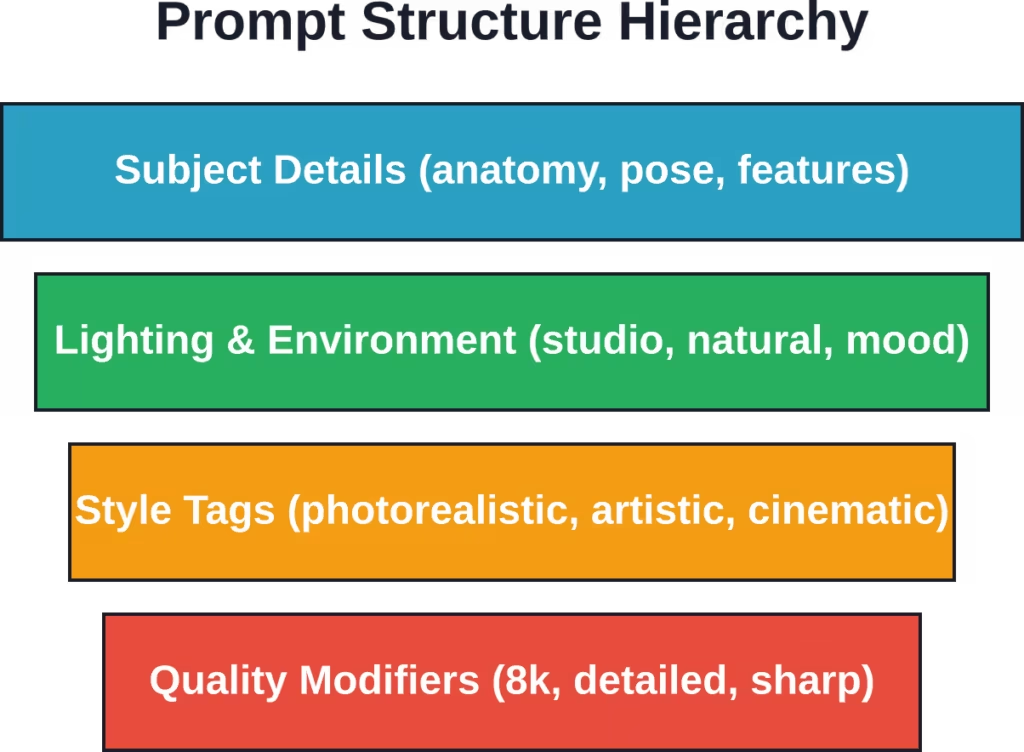
Successful NSFW prompts share common structural elements. They specify subject characteristics, pose details, environmental context, artistic style, and technical quality markers.
Generic prompts produce generic results. “Nude woman” generates blurry, inconsistent imagery. Prompt structures that include technical descriptors such as lighting conditions, style preferences, and resolution targets may influence model output characteristics.
Anatomical precision matters. Instead of vague terms, effective prompts reference specific body positions, angles, and proportions. Lighting descriptors—soft light, rim lighting, studio setup—dramatically affect realism.
Style tags control aesthetic direction. Terms like “hyperrealistic,” “cinematic,” “artistic nude,” or “boudoir photography” each trigger different model training associations. Combining multiple style markers refines output.
Negative prompts prevent common failures. Terms like “blurry, deformed, low quality, censored, watermark” explicitly tell the model what to avoid. This technique reduces the need for regeneration.
Tested NSFW Prompt Examples for 2026
Here are prompt structures that consistently produce high-quality results across major uncensored models.
Photorealistic Portrait Prompt
“Professional portrait photography, natural skin texture, soft diffused lighting, shallow depth of field, 50mm lens, detailed facial features, nude model, studio setting, high resolution 8k, photorealistic, anatomically correct.”
This formula balances technical photography terms with quality markers. The 50mm lens reference triggers training data from portrait photography. Adding “anatomically correct” reduces distortion errors common in AI-generated bodies.
Artistic Style Prompt
“Oil painting style, classical nude study, warm color palette, dramatic chiaroscuro lighting, renaissance composition, detailed brushwork, artistic nude, gallery quality, masterpiece.”
Artistic prompts bypass some content filters by framing output as fine art rather than explicit photography. Style-specific vocabulary guides the model toward trained artistic conventions.
Cinematic Scene Prompt
“Cinematic still, film grain, anamorphic lens flare, moody lighting, intimate scene, professional color grading, 4k resolution, realistic skin tones, detailed environment, shallow focus, atmospheric.”
Film terminology creates narrative context. References to grain, color grading, and anamorphic characteristics pull from cinema training data, often producing more sophisticated compositions.
Turn AI Art Ideas Into Character-Based Visuals
For readers working with AI art prompts, Cherrypop AI offers a character-first workflow that helps keep the visual idea more consistent. Users can create an AI character with description, personality, background story, and appearance details before moving into image or video generation. Instead of writing a new prompt from scratch every time, they can reuse the same character across different poses, outfits, backgrounds, and scene ideas.
Cherrypop AI can help with:
- creating reusable AI characters
- adding appearance and personality details
- testing different visual settings
- generating images and videos from prompts
👉Use Cherrypop AI to build a character first, then create visuals around it.
Technical Considerations for NSFW Generation
Model selection determines output capability. Stable Diffusion is a widely-used open-source model. The source material references CyberRealistic Pony in the context of NSFW content generation tools available in 2026.
Sampling steps affect detail quality. Lower step counts (20-30) generate faster but with less refinement. Higher counts (50-80) produce more detailed anatomy but increase generation time. Most realistic NSFW outputs use 40-60 steps.
CFG scale controls prompt adherence. Values of 7-10 balance creativity with prompt accuracy. Lower values introduce randomness; higher values create over-processed, artificial results.
Resolution impacts anatomical accuracy. Starting resolutions below 512×768 often produce distorted proportions. Upscaling algorithms like RealESRGAN improve final output quality after generation.
| Parameter | Recommended Range | Effect on Output |
|---|---|---|
| Sampling Steps | 40-60 | Detail quality and refinement |
| CFG Scale | 7-10 | Prompt adherence vs. creativity |
| Resolution | 512×768 minimum | Anatomical proportion accuracy |
| Seed Control | Fixed for consistency | Reproducible results |
| Negative Prompt Weight | 1.0-1.5 | Error prevention strength |
Ethical Boundaries and Legal Considerations
NSFW AI generation carries ethical responsibilities. Content depicting minors—even purely AI-generated imagery—constitutes illegal material in most jurisdictions. Federal and state laws increasingly address AI-generated child sexual abuse material.
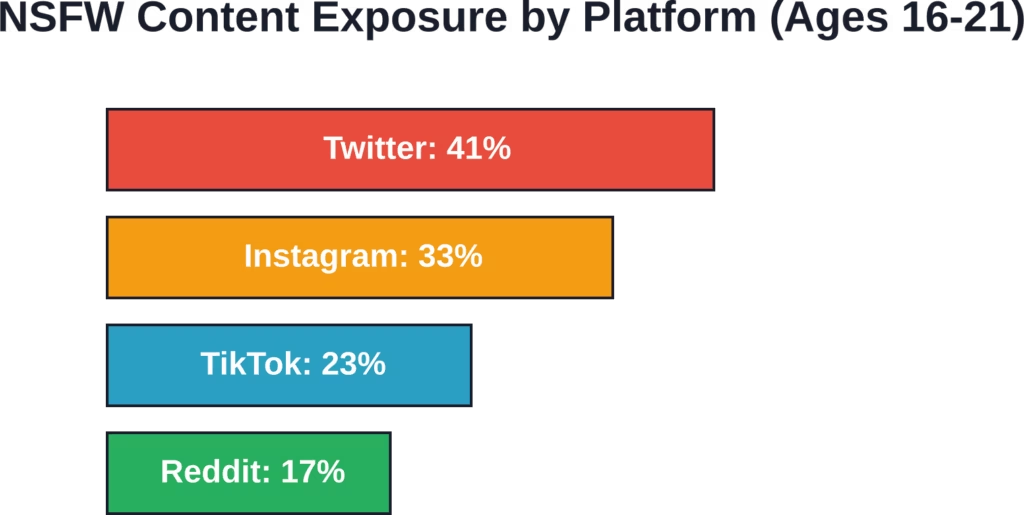
Research from academic institutions highlights concerning trends. According to data from arXiv research, 68.4% of adolescents in the U.S. have encountered NSFW content online. Research from the United Kingdom found that as of 2025, 55% of adolescents aged 14 to 17 had encountered inappropriate sexual or violent content.
Consent applies even to AI-generated faces. Creating realistic NSFW imagery resembling identifiable individuals without permission raises serious ethical and legal issues. Federal and state governments have outlawed nonconsensual sexual image sharing, with recent legal developments addressing AI-generated deepfakes, though U.S. legal clarity remains developing.
Responsible creators avoid generating content that depicts non-consensual scenarios, extreme violence, or illegal acts. Many NSFW AI communities establish guidelines prohibiting certain categories entirely.
Platform terms of service matter. Violating TOS can result in account termination and potential legal exposure. Reading and understanding platform policies before generating NSFW content prevents unintended violations.
Common Mistakes in NSFW Prompt Engineering
Over-complicated prompts often backfire. Stuffing 50+ descriptors into one prompt creates conflicting instructions. Models perform better with 15-25 focused, complementary terms.
Ignoring negative prompts leads to repeated generation failures. Common anatomical errors—extra fingers, distorted proportions, unnatural poses—require explicit negative terms to prevent.
Inconsistent terminology confuses models. Mixing photographic terms with painting descriptors produces muddled styles. Stick to vocabulary within a single aesthetic domain per prompt.
Neglecting composition guidance results in awkward framing. Terms like “centered subject,” “rule of thirds,” or “full body shot” provide spatial context that improves output.
Unrealistic expectations about first-generation output. Even with perfect prompts, NSFW generation typically requires multiple attempts and inpainting refinement for publication-quality results.
Moving Forward with Responsible NSFW AI Generation
The NSFW AI art generation has matured into a sophisticated field requiring technical knowledge, ethical awareness, and creative skill. Effective prompts balance specificity with model capability, while responsible practices respect legal boundaries and ethical considerations.
The tools available in 2026 offer unprecedented capability for creating customized adult content. Open-source models provide freedom from platform censorship, while active communities share knowledge and refined techniques.
But real talk: this technology carries responsibilities. The same tools that enable creative expression also create risks—from legal violations to harmful content proliferation. Research shows concerning exposure rates among young users, with research from arXiv studies indicating 68.4% of U.S. adolescents have encountered NSFW content online (Jiang et al., 2019).
Mastering prompt engineering takes experimentation. Start with tested formulas, adjust based on output, and build a library of effective prompts for different styles. Document what works—seed values, parameter combinations, and prompt structures that consistently produce quality results.
The landscape continues evolving. New models, improved moderation techniques, and changing regulations reshape what’s possible and permissible. Staying informed about legal developments and platform policies protects both creators and communities.
Frequently Asked Questions
Legality depends on jurisdiction and content type. Generating adult content depicting consenting adults for personal use is generally legal in most regions. However, creating imagery resembling minors or identifiable individuals without consent violates laws in many jurisdictions. Always verify local regulations before generating NSFW content.
Stable Diffusion community models fine-tuned on photographic datasets produce the most realistic results. Models like CyberRealistic, Realistic Vision, and similar checkpoints specifically train on high-quality adult photography. These typically outperform general-purpose models for anatomical accuracy and lighting realism.
Mainstream platforms like DALL-E, Midjourney, and commercial APIs employ strict content moderation. The only reliable method is using uncensored local installations of open-source models like Stable Diffusion or platforms specifically designed for adult content. No prompt engineering technique consistently bypasses modern moderation systems.
Anatomical distortions stem from insufficient training data, conflicting prompt instructions, or low sampling steps. Solutions include using models specifically trained on anatomical accuracy, increasing sampling steps to 50+, adding “anatomically correct” to prompts, and using negative prompts like “deformed, distorted, extra limbs, bad anatomy.”
Commercial use depends on the model license and local regulations. Most open-source Stable Diffusion models permit commercial use, but check specific license terms. Selling AI-generated adult content requires compliance with age verification laws, platform policies, and payment processor restrictions. Legal consultation is recommended before commercial distribution.
Lock the seed value to reproduce similar outputs with prompt variations. Use consistent base prompts with minor adjustments rather than completely rewriting each time. LoRA models trained on specific subjects or styles improve consistency. Inpainting allows refinement of specific areas without regenerating entire images.
Start with minimum 512×768 for portrait orientation or 768×512 for landscape. Higher resolutions like 768×1024 improve detail but require more VRAM and generation time. Generate at moderate resolution, then upscale using specialized AI upscalers like RealESRGAN or Ultimate SD Upscale for final high-resolution output.
Leave a Reply