Quick Summary: NSFW AI image prompts are specialized text instructions that guide AI image generators to create adult-oriented visual content. This guide explores effective prompt techniques, essential components like descriptive detail and style modifiers, and ethical considerations for responsible creation—all while highlighting the technical and policy landscape that shapes what’s possible with AI-generated NSFW content in 2026.
The landscape of AI image generation has transformed dramatically over the past few years. What started as experimental technology has evolved into sophisticated systems capable of producing photorealistic images from text descriptions.
And yes, that includes NSFW content.
But here’s the thing—creating quality NSFW AI images isn’t just about typing “make this sexy” into a generator. The difference between blurry, awkward outputs and genuinely realistic visuals comes down to how well crafted the prompts are. Prompt engineering for adult content requires understanding specific terminology, structure, and the technical limitations of different models.
What Are NSFW AI Image Prompts?
NSFW AI prompts are specially crafted text instructions designed to guide AI image generators toward producing mature, adult-themed, or sexually explicit visual content. These prompts serve as the blueprint that tells the AI model exactly what to render—from composition and subject matter to lighting, style, and level of detail.
The term “NSFW” (Not Safe For Work) covers a spectrum. Some prompts generate suggestive or artistic nude content, while others aim for explicit adult imagery. The specificity and structure of the prompt directly determine output quality.
Research from arXiv indicates that NSFW content detection in diffusion-based text-to-image models has become increasingly sophisticated, with in-generation detection systems achieving an average detection accuracy of 92.45% across multiple NSFW categories. This means platforms are actively monitoring and filtering content—making prompt crafting both an art and a technical challenge.
Why Prompt Quality Matters for NSFW Generation
Generic prompts produce generic results. Prompt engineering research indicates that vague descriptions like “attractive person” yield inconsistent outputs with poor anatomical accuracy, strange proportions, or that telltale AI “fog” effect.
Detailed prompts, on the other hand, give the AI model clear parameters. Specifying lighting conditions, pose details, camera angles, artistic style, and subject characteristics leads to dramatically better coherence and realism.
The challenge? Many mainstream AI platforms have implemented strict content filters. According to discussions on the OpenAI Developer Community published October 5, 2025, users have reported frustrations with policy enforcement that blocks even artistic nude content, despite official usage policies suggesting more nuanced allowances. One community member noted that filters sometimes reject legitimate artistic requests while inconsistently applying rules across different content types.
This creates a landscape where prompt engineering must navigate both technical optimization and platform restrictions.
Essential Components of Effective NSFW Prompts
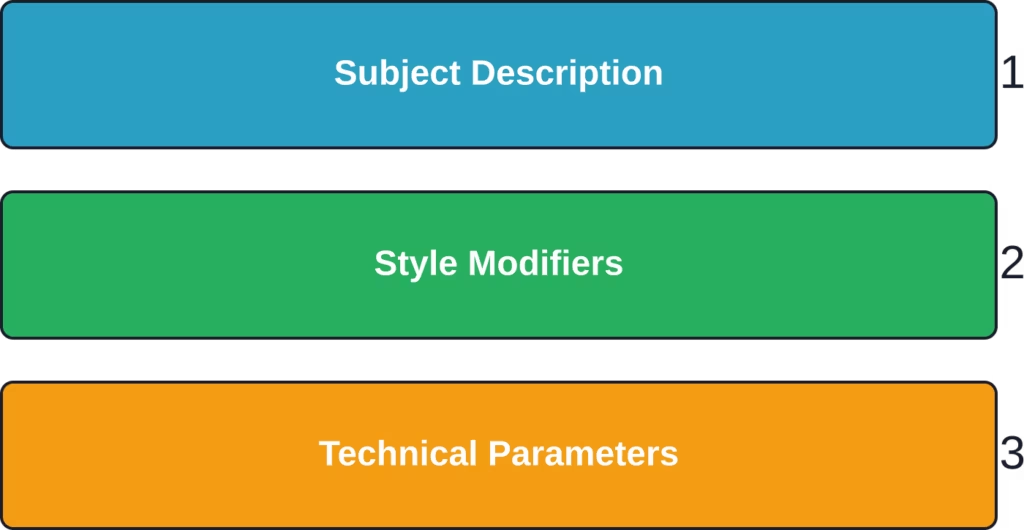
Based on analysis of prompt engineering practices across multiple platforms, certain prompt patterns are designed to produce higher-quality outputs. Breaking down these components helps craft instructions that consistently generate quality results.
Subject Description and Detail Level
Start with clear subject identification. Specify physical characteristics, pose, expression, and context. The more concrete the details, the better the model can interpret intent.
Effective prompts include:
- Physical attributes (body type, facial features, hair color and style)
- Pose and positioning (standing, reclining, specific angle)
- Emotional tone or expression (confident, playful, intimate)
- Clothing or lack thereof (specific garments, partial clothing, nude)
Avoid vague terms. Instead of “beautiful woman,” try “athletic woman with auburn hair, confident expression, three-quarter view.”
Style and Artistic Modifiers
Style descriptors tell the AI what aesthetic framework to apply. This dramatically affects the final output’s look and feel.
Common style modifiers include:
- Photorealistic / hyperrealistic
- Cinematic photography
- Artistic nude (classical, modern, abstract)
- Digital illustration / anime style
- Vintage film photography
Combining styles can produce unique results. “Photorealistic portrait with cinematic lighting” yields different outputs than “soft watercolor artistic nude.”
Technical Parameters
Professional-grade prompts often include technical photography or rendering terms:
- Lighting setup (soft natural light, studio lighting, golden hour, rim lighting)
- Camera specifications (50mm lens, shallow depth of field, bokeh background)
- Composition rules (rule of thirds, centered composition, close-up)
- Image quality descriptors (high resolution, detailed, sharp focus)
These technical additions help the model understand not just what to show, but how to show it.
Platform Considerations and Policy Landscape
The reality? Not all AI image generators handle NSFW content equally. Platform policies vary widely, and enforcement can be inconsistent.
According to OpenAI’s usage policies (effective October 29, 2025), the company aims to balance user freedom with safety considerations. However, community discussions reveal ongoing tension between stated policies and actual filter behavior. Users report that models sometimes refuse artistic nude generation despite policies allowing it, while enforcement appears uneven across different content categories.
Research on video deepfake abuse patterns shows that since 2022, when AI image generators crossed a threshold enabling photorealistic output, misuse of these technologies has surged significantly. According to a report from ActiveFence, estimated threads related to AIG-NCII depicting private individuals rose by 400% between 2022 and 2023.
This backdrop explains why major platforms implement aggressive filtering—even when it frustrates legitimate artistic use cases.
Uncensored vs. Filtered Platforms
The AI image generation landscape splits into two categories: platforms with strict content filters (like mainstream services from major tech companies) and uncensored alternatives that allow NSFW content with fewer restrictions.
Filtered platforms typically:
- Block explicit prompts automatically
- Flag and refuse generation mid-process
- Limit or ban accounts that repeatedly attempt NSFW content
- Apply inconsistent enforcement across artistic styles
Uncensored platforms generally:
- Allow explicit adult content generation
- Require age verification or content warnings
- Place responsibility on users for legal compliance
- May have limited features or less sophisticated models
Real talk: if consistent NSFW generation is the goal, uncensored platforms designed specifically for that purpose typically deliver better results than trying to work around mainstream filters.
Generate AI Character Images With Cherrypop AI
For readers looking for more control over AI image prompts, Cherrypop AI offers a character-first setup instead of starting with a blank prompt box. The platform lets users build AI characters and then use them in image or video generation. Its Generate tool includes options for character selection, pose, outfit, background, orientation, prompt details, and advanced settings. That gives users a clearer structure when they want the final image to follow a specific character concept.
Cherrypop AI can assist with:
- building reusable AI characters
- generating image and video content
- adjusting pose, outfit, and background
- keeping characters public or private
👉Use Cherrypop AI to build a character first, then generate images around it.
Tested NSFW Prompt Structures That Work
Based on analysis of prompt engineering practices across multiple platforms, certain prompt patterns are designed to produce higher-quality outputs. These structures can be adapted and modified for specific needs.
The Detailed Portrait Approach
This structure focuses on creating realistic character-focused images with controlled composition.
- Template: “[Physical description], [pose/positioning], [clothing/state], [expression/mood], [style descriptor], [lighting], [camera angle], [technical quality]”
- Example: “Athletic woman with long dark hair, reclining pose, wearing silk robe partially open, confident sultry expression, photorealistic style, soft golden hour lighting, shot from slightly above, 50mm lens with shallow depth of field, high detail”
The Artistic Context Method
This approach frames the content within an artistic or aesthetic context, which can sometimes bypass filters while producing sophisticated results.
- Template: “[Art style] of [subject], [compositional elements], [mood/atmosphere], [medium/technique], [artist reference or era]”
- Example: “Classical oil painting of female figure in repose, draped fabric partially covering, Renaissance-inspired composition, warm candlelight atmosphere, Caravaggio lighting technique, museum quality”
The Technical Photography Format
Photography-specific terminology often produces the most realistic outputs on models trained heavily on photographic datasets.
- Template: “[Subject], [specific pose], [wardrobe detail], professional photography, [lens specification], [lighting setup], [depth of field], [color grading], [resolution quality]”
- Example: “Woman standing by window, back view looking over shoulder, lace lingerie, professional boudoir photography, 85mm f/1.4 lens, natural window light with reflector fill, bokeh background, warm color grade, 8k resolution”
| Prompt Approach | Best For | Filter Resistance | Realism Level |
|---|---|---|---|
| Detailed Portrait | Character-focused images | Medium | High |
| Artistic Context | Stylized or tasteful content | Higher | Medium-High |
| Technical Photography | Photorealistic outputs | Medium-Low | Very High |
| Anime/Illustration | Stylized digital art | Higher | Low (stylized) |
Common Mistakes That Ruin NSFW Outputs
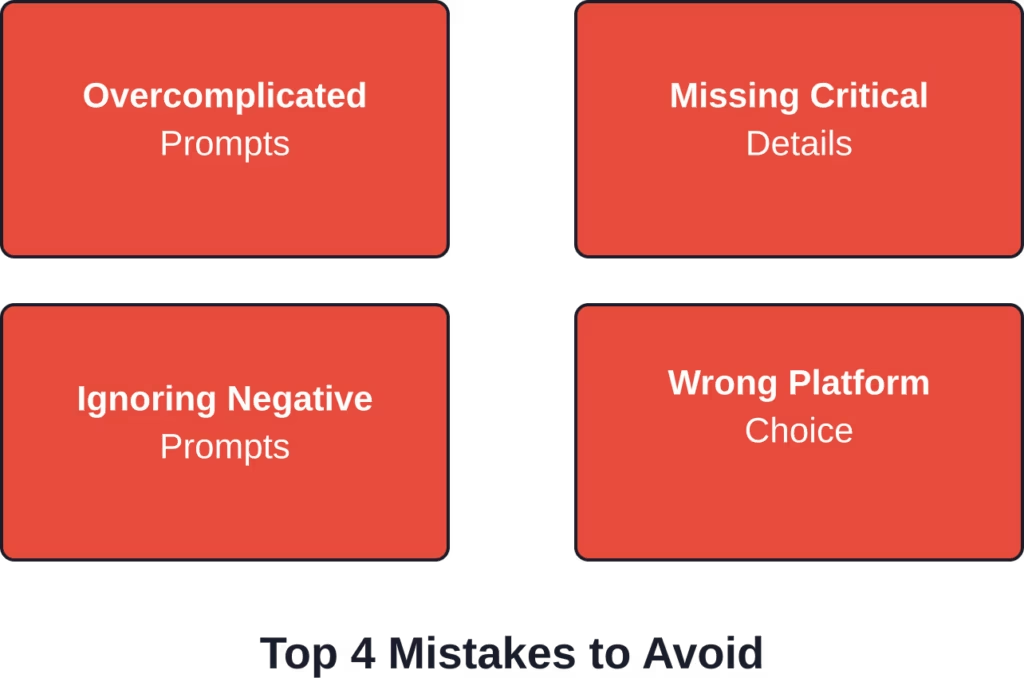
Even experienced users make predictable errors that degrade image quality. Avoiding these pitfalls dramatically improves results.
Overcomplicated Prompts
Cramming too many conflicting descriptors confuses the model. “Athletic curvy petite tall woman with blonde dark red hair” gives the AI contradictory instructions. Pick a clear, consistent description instead.
Missing Critical Details
Vague prompts leave too much to chance. Without specifying lighting, angle, or style, the model fills gaps unpredictably—often producing flat, poorly lit, or awkwardly composed images.
Ignoring Negative Prompts
Many generators support negative prompts—terms that tell the AI what NOT to include. Forgetting to exclude common problems (“blurry, distorted, bad anatomy, extra limbs, low quality”) often results in outputs with those exact issues.
Unrealistic Expectations for Filtered Platforms
Attempting explicit content generation on heavily filtered mainstream platforms wastes time and risks account restrictions. Match the platform to the content goal.
Ethical Considerations and Responsible Creation
The technical capability to generate NSFW AI images carries significant ethical responsibilities. Research into AI-generated content shows serious misuse patterns, particularly regarding non-consensual imagery.
According to Stanford HAI research, AI-powered “nudify” apps have been misused to create non-consensual intimate images, including child sexual abuse material. Educational institutions have documented cases of students using these tools to create harmful content targeting peers—highlighting urgent policy and prevention needs.
Responsible NSFW AI creation means:
- Never creating images depicting real individuals without explicit consent
- Avoiding generation of content depicting minors in any form
- Understanding legal frameworks around synthetic pornography in your jurisdiction
- Respecting platform terms of service and usage policies
- Not distributing AI-generated content deceptively as real photography
The technology itself is neutral—ethical implications arise from how it’s used. Creating artistic nude content or personal adult imagery differs fundamentally from generating non-consensual depictions or illegal material.
Advanced Techniques for Better Results
Once basic prompt structure is mastered, several advanced techniques can push quality even higher.
Iterative Refinement
Generate an initial image, then refine the prompt based on what worked and what didn’t. If the pose is correct but lighting is flat, keep the pose description and enhance lighting terms. This iterative approach gradually dials in exactly what works for a specific model.
Model-Specific Optimization
Different AI models respond better to different prompt styles. Some models trained heavily on artistic datasets respond well to painter names and art movement references. Others trained on photography datasets prefer technical camera terminology.
Practitioners report that understanding which model underlies a platform (Stable Diffusion variants, proprietary models, etc.) helps optimize prompt structure for that specific system.
Weight and Emphasis Modifiers
Some platforms support emphasis syntax—ways to tell the model which parts of the prompt matter most. Common formats include parentheses for emphasis “(detailed face)” or numerical weights “detailed face:1.5”.
This fine control helps when certain elements consistently render poorly. Increasing weight on “anatomically correct hands” can reduce the infamous AI hand-rendering problems.
Moving Forward With NSFW AI Generation
The technology behind AI image generation continues evolving rapidly. What produces cutting-edge results today will be surpassed by more sophisticated models within months.
But the fundamentals of effective prompt engineering remain consistent: clear subject description, appropriate style modifiers, technical parameters, and thoughtful structure. These core principles translate across platforms and model generations.
The key is balancing creative goals with ethical responsibility. NSFW AI image generation is a powerful creative tool when used appropriately—for artistic expression, personal content creation, or exploring visual concepts.
Start with the prompt structures outlined here, experiment with variations, and refine based on results. Pay attention to which descriptors produce the best outputs on your chosen platform, and build a personal library of effective prompts.
Most importantly? Stay informed about the evolving policy landscape, respect platform guidelines, and prioritize ethical creation practices. The technology isn’t going anywhere—learning to use it responsibly ensures access continues while minimizing harm.
Ready to create? Start with clear, detailed prompts. Test iteratively. And remember—the difference between mediocre and exceptional AI-generated images comes down to how well you communicate your vision to the model.
Frequently Asked Questions
Legality varies by jurisdiction and use case. Creating fictional adult content for personal use is generally legal in most regions. However, generating images depicting real people without consent, creating content depicting minors, or distributing AI-generated material deceptively may violate laws. Always check local regulations and platform terms of service.
Mainstream AI platforms implement content filters to prevent policy violations and misuse. According to OpenAI community discussions, enforcement can be inconsistent even when policies technically allow artistic content. Using uncensored platforms specifically designed for adult content typically provides more reliable generation without filter interference.
Style descriptors in the prompt control this. Terms like “photorealistic,” “professional photography,” and specific camera/lens details push toward realism. Terms like “anime style,” “illustration,” or “cartoon” produce stylized outputs. The underlying model’s training data also matters—models trained primarily on photographs produce better realistic outputs.
Generally, more specific is better. Vague prompts like “attractive person” leave too much to the model’s interpretation. Detailed prompts specifying physical characteristics, pose, lighting, style, and technical parameters consistently produce higher-quality, more controllable outputs. The sweet spot is typically 20-40 descriptive terms without contradictory elements.
This is both ethically problematic and often technically blocked. Many platforms explicitly prohibit prompts referencing real individuals to prevent non-consensual imagery creation. Beyond platform restrictions, creating NSFW content depicting real people without consent raises serious ethical and potentially legal issues. Focus on fictional characters or original descriptions instead.
Negative prompts tell the AI what NOT to include in the generated image. Common negative terms include “blurry, distorted, bad anatomy, low quality, extra limbs.” Including these helps the model avoid common failure modes, resulting in cleaner outputs with better anatomical accuracy and image quality.
Blurriness typically results from insufficient detail in prompts or low-quality model settings. Add specific terms like “sharp focus,” “high detail,” “8k resolution,” and “crisp” to prompts. Include negative terms like “blurry, soft focus, low resolution.” Additionally, some generators have quality settings—using higher steps or CFG scale values often reduces fogginess.
Leave a Reply