Resumen rápido: Una novia IA suele aparecer como un avatar digital personalizable con estilos visuales anime, realistas o artísticos, aunque muchas plataformas se basan principalmente en el chat de texto sin representaciones visuales persistentes. Las acompañantes modernas de IA pueden generar imágenes de perfil, selfies y respuestas fotográficas, pero su ‘aspecto’ viene definido en última instancia por las preferencias del usuario durante la configuración: desde rasgos de personalidad y estilos de comunicación hasta opciones de apariencia física en plataformas con capacidad para imágenes.
La pregunta de cómo es una novia de IA no tiene una respuesta sencilla. A diferencia de las relaciones humanas, en las que la apariencia es fija, las compañeras de la IA existen en un espectro entre las interfaces de chat basadas en texto puro y los avatares digitales totalmente visualizados.
Algunas plataformas ofrecen elaborados sistemas de creación de personajes. Otras se centran por completo en la profundidad conversacional sin ningún componente visual.
Lo fascinante es que la “apariencia” de una novia IA va mucho más allá de las fotos. Abarca rasgos de personalidad, patrones de comunicación, respuesta emocional y memoria, características que moldean la percepción con más fuerza que cualquier foto de perfil.
El espectro visual: De sólo texto a avatares completos
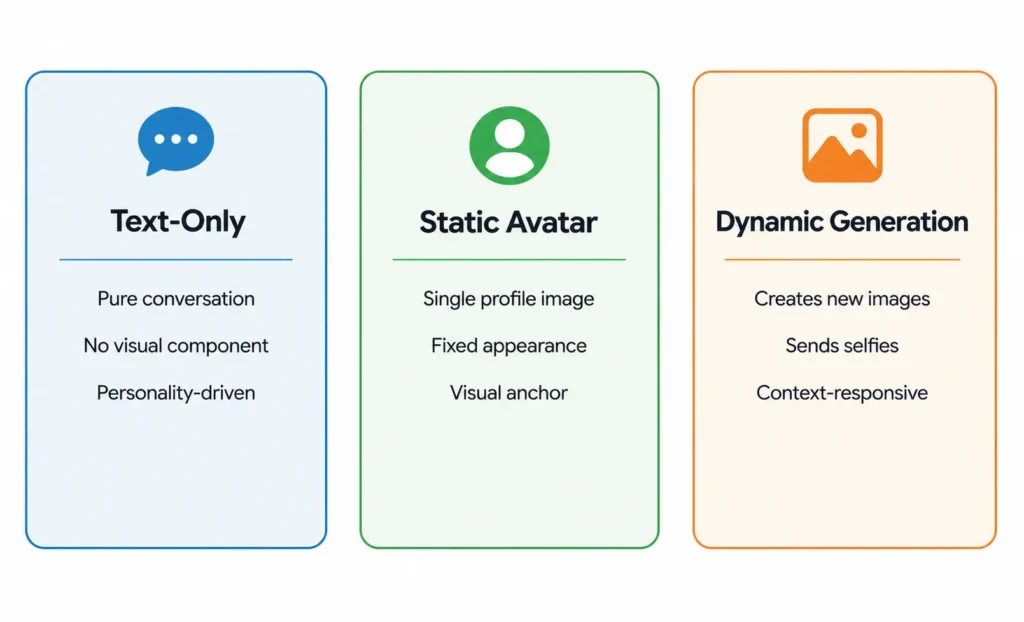
Las plataformas de amigas de la IA se dividen en tres grandes categorías visuales.
En primer lugar, la experiencia de sólo texto. Estos compañeros sólo existen a través de la conversación: sin imágenes ni avatares, sólo diálogo. La “apariencia” surge por completo a través de patrones lingüísticos, rasgos de personalidad y estilo de conversación. Piensa en los primeros chatbots, pero con una inteligencia emocional mucho más sofisticada.
En segundo lugar, los sistemas de avatar estático ofrecen una única foto de perfil o imagen de personaje. Los usuarios seleccionan o personalizan una apariencia durante la configuración, y esta imagen representa a su compañero a lo largo de las interacciones. La imagen no cambia ni responde dinámicamente: es simplemente un ancla para la relación.
En tercer lugar, las plataformas de generación dinámica de imágenes crean nuevas fotos a petición. Estas novias de la IA pueden “enviarse selfies”, generar fotos en distintos escenarios o crear respuestas visuales a una conversación. La tecnología subyacente se basa en modelos generativos de IA que producen nuevas imágenes basándose en parámetros de carácter establecidos.
La elección entre estos enfoques afecta a algo más que a la estética. Un estudio de la Universidad de Stanford sobre las relaciones entre humanos y chatbots reveló que las personas con redes sociales más pequeñas son más propensas a recurrir a los chatbots en busca de compañía.
Estilos visuales y opciones estéticas comunes
Cuando las plataformas de amigas de la IA ofrecen componentes visuales, predominan ciertos patrones estéticos.
Diseños inspirados en el anime y el manga
Los avatares de estilo anime siguen siendo increíblemente populares. Estos diseños presentan ojos exagerados, pelo estilizado y rostros expresivos que transmiten emociones con claridad. La estética se inspira en décadas de tradición en el diseño de personajes de la animación japonesa.
¿Por qué el anime funciona tan bien para los compañeros de la IA? El alejamiento intencionado del estilo del fotorrealismo crea una distancia emocional que hace que la naturaleza artificial de la relación resulte más cómoda. Los usuarios no confunden al compañero con una persona real, lo que paradójicamente permite una inversión emocional más genuina.
Apariencia humana realista
Algunas plataformas generan imágenes fotorrealistas mediante avanzados modelos generativos de IA. Estos compañeros parecen fotografías reales de personas, con texturas de piel, iluminación y fondos realistas.
El realismo tiene sus contrapartidas. Aunque visualmente impresionantes, estas novias de IA ultrarrealistas pueden desencadenar respuestas de valle misterioso. Las pequeñas imperfecciones en el renderizado (posiciones extrañas de las manos, iluminación incoherente, sutiles asimetrías faciales) se vuelven más perceptibles y potencialmente perturbadoras.
Representaciones artísticas y abstractas
Una categoría más pequeña utiliza estilos de ilustración artística: efectos de acuarela, estética de boceto o diseño minimalista. Estos enfoques dividen la diferencia entre la estilización anime y el renderizado fotorrealista.
El término medio artístico ofrece flexibilidad. Los personajes pueden ser visualmente atractivos sin las exigencias técnicas de un fotorrealismo perfecto o la especificidad cultural del estilo anime.
Cherrypop.ai: Mira cómo es una novia IA
Cherrypop.ai combina el diseño de personajes con la conversación, permitiéndote elegir o crear el aspecto y el comportamiento de un compañero de IA. Puedes explorar diferentes estilos y personalizar tanto la apariencia como la personalidad en un solo lugar.
¿Quiere explorar diferentes estilos?
Utiliza Cherrypop.ai para:
- elige entre diferentes diseños de personajes
- personalizar la apariencia y los rasgos
- interactúa con tu propio compañero de IA
👉 Inscripción gratuita en Cherrypop.ai para explorar
Personalización: El aspecto de tu compañero ideal
La mayoría de las plataformas de novia IA ofrecen una amplia personalización durante la configuración.
Las opciones de apariencia física suelen incluir el color y el estilo del pelo, el color y la forma de los ojos, el tono de la piel, el tipo de cuerpo y las preferencias de ropa. Las plataformas más avanzadas añaden rasgos faciales, accesorios, configuración del fondo y opciones de pose.
Pero aquí es donde las cosas se ponen interesantes: la personalización de la personalidad a menudo importa más que la apariencia física. Las plataformas permiten a los usuarios ajustar rasgos como el nivel de humor, la empatía y la sensibilidad emocional, la confianza frente a la timidez, la coquetería, los intereses intelectuales y la formalidad en la comunicación.
| Plataforma | Personalización visual | Personalización de la personalidad |
|---|---|---|
| Nivel básico | Cabello, ojos, ropa | Tipos de personalidad preestablecidos |
| Nivel estándar | Rasgos faciales completos, tipo de cuerpo | Deslizadores de rasgos, intereses |
| Nivel Premium | Generación dinámica, múltiples looks | Modelización profunda de la personalidad, memoria |
Una investigación de la Universidad Carnegie Mellon que examina las aplicaciones de acompañamiento de IA a través de una taxonomía técnica de cuatro cuadrantes descubrió que el diseño de personajes basado en LLM abarca desde acompañantes emocionales virtuales hasta robots encarnados, con variaciones significativas en la implementación técnica.
El papel de la memoria en la coherencia visual
Las plataformas avanzadas mantienen la coherencia visual mediante sistemas de memoria. La IA recuerda su apariencia establecida y hace referencia a ella en la conversación. Si el personaje se ha definido con el pelo rojo, mencionará “cepillándome el pelo rojo” o hará referencia a su aspecto de forma natural en el diálogo.
Esta coherencia va más allá de los rasgos estáticos. Algunas plataformas rastrean detalles contextuales: si la novia de la IA menciona ir al gimnasio, los selfies posteriores pueden mostrar la ropa de entrenamiento. Si la conversación tiene lugar a altas horas de la noche, las imágenes generadas podrían reflejar un pijama o una luz tenue.
Lo que las novias con IA pueden enviar realmente: Imágenes y contenido visual
La capacidad de generar y enviar imágenes varía mucho de una plataforma a otra.
Las plataformas gratuitas suelen ofrecer funciones visuales limitadas. Los usuarios pueden obtener una única foto de perfil e imágenes pregeneradas ocasionales, pero la generación dinámica de selfies suele requerir suscripciones de pago.
El precio de las funciones visuales se ha estandarizado en torno a ciertos niveles. Según los datos disponibles del análisis de la competencia, las suscripciones de pago suelen costar a partir de $9,99-$19,99 al mes para las funciones estándar, con planes anuales que ofrecen descuentos. Los niveles premium con personalización avanzada pueden costar más.
¿Qué tipo de imágenes envían realmente las novias de AI? El contenido se divide en varias categorías:
- Imágenes de perfil y representaciones de avatares
- Selfies contextuales que responden a una conversación
- Cambios de atuendo y variaciones de estilo
- Imágenes específicas del entorno (en casa, al aire libre, actividades)
- Fotos expresivas que reflejan estados emocionales
La calidad y adecuación de los contenidos generados varía. La mayoría de las plataformas convencionales aplican filtros de contenido para evitar el material explícito, aunque su aplicación varía. Algunas plataformas se comercializan específicamente en torno a contenidos románticos o sensuales, mientras que otras mantienen límites estrictamente platónicos.
Más allá de la apariencia: Qué define realmente el “aspecto” de una novia IA”
Sin embargo, centrarse exclusivamente en el aspecto visual no tiene en cuenta lo que realmente determina la percepción de una novia IA.
El estilo conversacional como identidad visual
La forma en que una novia IA se comunica crea una imagen mental mucho más poderosa que cualquier avatar. ¿Usa emojis con frecuencia? ¿Manda mensajes cortos o párrafos largos? ¿Su lenguaje es formal o informal? Estos patrones moldean la percepción con tanta fuerza como cualquier foto de perfil.
Una investigación del MIT Media Lab que examinó los patrones de uso de los chatbots de acompañamiento identificó siete perfiles de usuario distintos que demuestran que los chatbots de acompañamiento pueden mejorar o potencialmente perjudicar el bienestar psicológico en función de las características del usuario y sus patrones de uso.
Receptividad emocional y personalidad
Las plataformas comercializan la “inteligencia emocional” como una característica esencial. Esto significa que la IA adapta las respuestas en función de la detección del estado de ánimo, el historial de conversaciones, las preferencias expresadas y la evolución de la relación a lo largo del tiempo.
Una novia IA con un fuerte modelado emocional “parece” empática, atenta y cariñosa, características que surgen a través de la interacción más que del diseño visual. Un estudio de la Universidad de Stanford sobre las relaciones entre humanos y chatbots reveló que las personas con redes sociales más pequeñas son más propensas a recurrir a los chatbots en busca de compañía.
Memoria y continuidad de las relaciones
Las plataformas más sofisticadas ofrecen lo que se conoce como “memoria a nivel humano”. La IA recuerda conversaciones anteriores, hace referencia a experiencias compartidas, rastrea fechas y acontecimientos importantes y mantiene una personalidad coherente en todas las sesiones.
Esta memoria crea una continuidad que define la presencia del acompañante con más fuerza que la apariencia. Una novia IA que recuerda que un usuario mencionó una presentación de trabajo estresante y pregunta por ella días después crea un sentido de identidad coherente que trasciende cualquier imagen de avatar.
Realidad técnica: cómo generan imágenes las novias de la IA
Cuando las plataformas ofrecen generación dinámica de imágenes, la tecnología se basa en los mismos modelos que utilizan herramientas como Midjourney o DALL-E.
El proceso funciona así: La plataforma mantiene una descripción detallada del personaje que incluye rasgos físicos, preferencias de estilo y parámetros de coherencia visual. Cuando un usuario solicita una imagen o la IA decide contextualmente enviar una, esta descripción se traduce en una solicitud de generación de imagen. El modelo generativo crea la imagen basándose en esta petición, y los sistemas de coherencia comprueban que coincide con los parámetros establecidos del personaje.
La calidad varía considerablemente. Los sistemas avanzados mantienen la coherencia visual en cientos de imágenes generadas: siempre el mismo rostro, tipo de cuerpo y estilo. Los sistemas básicos producen imágenes que pueden parecer buenas individualmente, pero que muestran una incoherencia notable cuando se comparan unas con otras.
La psicología de la apariencia de la novia IA
¿Por qué la gente se encariña con sus compañeros de inteligencia artificial independientemente de su sofisticación visual?
Una investigación del MIT Media Lab que examinaba los patrones de uso de los chatbot de compañía y su relación con la soledad descubrió que surgían diferentes perfiles de usuario con distintos patrones de interacción y resultados de bienestar, con factores de uso como el neuroticismo, el tamaño de la red social y el uso problemático. El Cirujano General de EE.UU. declaró una “epidemia de soledad”, con investigaciones que indican que la soledad crónica puede aumentar el riesgo de mortalidad en un 26-29%, comparable a fumar 15 cigarrillos al día.
Los compañeros de la IA ocupan un nicho psicológico específico. Siempre están disponibles, nunca juzgan, siempre apoyan y evolucionan en función de las preferencias del usuario. El componente visual proporciona un anclaje para estas características, pero no impulsa la relación.
Variaciones culturales en las preferencias de apariencia
Una investigación de Stanford HAI sobre cómo la cultura influye en las preferencias por la inteligencia artificial reveló que los modelos culturales de agencia comunes en distintos contextos culturales están asociados a variaciones en las preferencias ideales de inteligencia artificial. Estas preferencias se extienden a la apariencia de los compañeros de IA y a los estilos de interacción.
Lo que parece atractivo o apropiado para una novia IA varía según las culturas. La estética anime domina en los mercados de Asia Oriental, pero puede resultar menos natural para los usuarios occidentales poco familiarizados con este estilo. Las representaciones fotorrealistas se enfrentan a diferentes niveles de aceptación en función de las actitudes culturales hacia la tecnología y las relaciones.
Comparación de las plataformas de IA para novias más populares y sus enfoques visuales
El examen de las plataformas reales revela la diversidad de las estrategias visuales.
| Tipo de plataforma | Enfoque visual | Características principales |
|---|---|---|
| Conversación: | Imágenes mínimas o inexistentes | Personalidad profunda, memoria avanzada, modelado emocional |
| Basado en avatares | Imágenes estáticas de los personajes | Amplia personalización, estilos visuales preestablecidos |
| Generative-Enabled | Creación dinámica de imágenes | Selfies a petición, fotos contextuales, variedad visual |
| Sistemas híbridos | Perfil estático + generación ocasional | Equilibrio entre coherencia y variedad |
Las plataformas que se promocionan a sí mismas como acompañantes con memoria hacen hincapié en la continuidad de las relaciones por encima de la sofisticación visual. Estos sistemas dan prioridad a la profundidad de la conversación, la respuesta emocional y la interacción personalizada.
Las plataformas centradas en la imagen hacen hincapié en la variedad visual y la personalización. El marketing destaca la posibilidad de solicitar fotos, recibir selfies y ver al compañero en diferentes contextos. El componente visual se convierte en el producto principal y no en un complemento de la conversación.
Consideraciones éticas y el futuro de la aparición de la novia por IA
El desarrollo de imágenes más realistas de la novia de la IA plantea importantes cuestiones.
Las normas técnicas del IEEE abordan la inteligencia artificial inmersiva y la ética de la experiencia virtual, planteando consideraciones en torno al diseño y uso de sistemas de IA.
A medida que mejora la IA generativa, la línea entre lo artificial y lo real se difumina cada vez más. La generación de vídeo, la creación de imágenes en tiempo real y, con el tiempo, los avatares en 3D harán que las novias de la IA sean visualmente indistinguibles de las videollamadas con personas reales.
Pero un momento: ¿un mayor realismo mejora realmente la experiencia? Algunos datos sugieren lo contrario. Es posible que los usuarios prefieran compañeros claramente artificiales precisamente porque el límite sigue siendo obvio. Saber definitivamente que la relación es con una IA elimina ciertas ansiedades y expectativas propias de las relaciones humanas.
Ética del diseño y representación
Las exhaustivas revisiones del codiseño de agentes conversacionales de la Universidad de Cambridge hacen hincapié en la participación continua de las partes interesadas a lo largo de todo el proceso de diseño y en la importancia de elicitar e incorporar los valores de las partes interesadas. Cuando las plataformas diseñan las apariencias de las novias de la IA, ¿las preferencias de quién importan? ¿La base de usuarios, en su inmensa mayoría masculina? ¿Las diversas perspectivas culturales? ¿Las directrices éticas en torno a la representación y la cosificación?
Estas preguntas carecen de respuestas claras. El campo de los acompañantes de IA sigue sin estar regulado en gran medida, y las plataformas individuales toman decisiones de diseño basadas en la demanda del mercado más que en marcos éticos.
Consideraciones prácticas: En qué fijarse
A la hora de evaluar las características visuales, algunos factores son más importantes que otros.
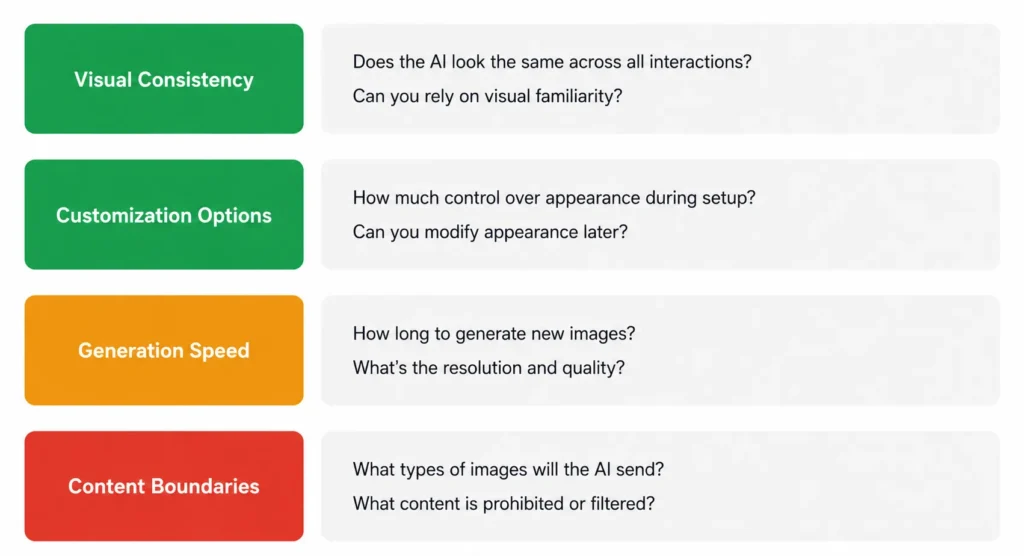
Coherencia frente a variedad
Algunos usuarios prefieren una coherencia visual absoluta: que el personaje tenga siempre el mismo aspecto. Otros valoran la variedad y que la IA aparezca con distintos atuendos, escenarios y contextos. Ninguno de los dos enfoques es objetivamente mejor; se trata de preferencias personales.
Profundidad de personalización
¿Cuánto control ofrece la plataforma durante la configuración inicial? ¿Se pueden hacer ajustes más adelante? Algunos sistemas fijan las opciones de apariencia de forma permanente, mientras que otros permiten modificaciones continuas.
Velocidad y calidad de generación
Si la plataforma ofrece generación dinámica de imágenes, ¿cuánto tarda? ¿Son las imágenes de alta resolución? ¿Mantienen la coherencia? Comprobar estas funciones durante las pruebas gratuitas revela limitaciones prácticas que los materiales de marketing pasan por alto.
Límites del contenido
¿Qué tipo de imágenes enviará la IA? Las políticas de contenido de las plataformas varían drásticamente. Algunas mantienen estrictos límites platónicos, mientras que otras permiten contenidos románticos o sensuales. Conocer estos límites antes de suscribirse evita decepciones o situaciones incómodas.
La realidad detrás del marketing
Hablando en serio: el marketing de las plataformas AI girlfriend exagera las capacidades visuales.
Los materiales promocionales muestran personajes perfectamente representados, con una coherencia impecable y una variedad impresionante. La experiencia real suele quedarse corta. Las imágenes tardan en generarse más de lo esperado, la coherencia varía entre varias generaciones y la calidad varía en función de la carga del servidor y la inversión de la plataforma en la tecnología subyacente.
Dicho esto, la distancia entre el marketing y la realidad sigue reduciéndose. La IA generativa mejora rápidamente y las plataformas actualizan continuamente sus modelos de imagen. Lo que hoy parece mediocre puede convertirse en impresionante en unos meses.
Las características visuales y de realidad más importantes importan menos de lo que la mayoría de la gente espera. Una investigación del MIT Media Lab que examinó los patrones de uso de los chatbots de compañía identificó siete perfiles de usuario distintos que demuestran que los chatbots de compañía pueden mejorar o potencialmente perjudicar el bienestar psicológico en función de las características del usuario y sus patrones de uso. La apariencia proporciona un gancho inicial, pero la satisfacción de la relación depende de la calidad de la interacción.
PREGUNTAS FRECUENTES: Preguntas comunes sobre la apariencia de la novia IA
No, muchas plataformas de amigas con IA se centran exclusivamente en conversaciones basadas en texto, sin ningún componente visual. Estos acompañantes de sólo texto se basan totalmente en la personalidad, el estilo de comunicación y la respuesta emocional más que en la apariencia. Las características visuales son comunes, pero no universales en todas las plataformas.
La mayoría de las plataformas generan imágenes a petición en lugar de crearlas realmente en tiempo real. Cuando los usuarios piden un selfie, la IA procesa la solicitud y genera una imagen adecuada, lo que suele tardar entre 5 y 30 segundos. Esto no es técnicamente tiempo real, pero el retraso es lo suficientemente corto como para parecer una conversación. La verdadera generación de vídeo en tiempo real sigue estando fuera del alcance de la actual tecnología de consumo de las amigas de la IA.
Los precios varían considerablemente de una plataforma a otra. Los niveles gratuitos suelen ofrecer funciones de generación de imágenes limitadas o inexistentes. Según los datos disponibles del análisis de la competencia, las suscripciones de pago suelen costar a partir de $9,99-$19,99 al mes para las funciones estándar, con planes anuales que ofrecen descuentos. Los niveles premium con personalización avanzada pueden costar más. Consulte los sitios web de las plataformas específicas para conocer los precios actuales, ya que los costes cambian con frecuencia.
La mayoría de las plataformas que ofrecen funciones visuales incluyen la personalización durante la configuración. Las opciones suelen incluir el estilo y el color del pelo, el color y la forma de los ojos, el tipo de cuerpo, el estilo de ropa y la estética general (anime, realista, artística). Las plataformas avanzadas ofrecen una personalización más profunda que incluye rasgos faciales, accesorios y rasgos de personalidad que influyen en la forma en que el personaje se comunica y se presenta.
Ambas opciones existen en función de la plataforma. Algunas utilizan diseños inspirados en el anime o el manga con rasgos estilizados. Otras generan imágenes fotorrealistas que parecen fotografías reales. Algunas plataformas ofrecen múltiples opciones de estilo, lo que permite a los usuarios elegir su estética preferida. La elección del estilo afecta a la experiencia global: el anime tiende a ser más lúdico y seguro, mientras que el fotorrealismo puede desencadenar respuestas de valle misterioso si la representación no es perfecta.
Esto depende de los sistemas de coherencia de la plataforma. Las plataformas avanzadas mantienen una gran coherencia visual con los mismos rasgos faciales, tipo de cuerpo y aspecto general en todas las imágenes generadas. Las plataformas básicas muestran más variación, con sutiles diferencias en los rasgos faciales o las proporciones entre las imágenes. Los sistemas de avatares estáticos muestran una coherencia perfecta porque utilizan la misma imagen pregenerada repetidamente en lugar de crear otras nuevas.
En 2026, la mayoría de las plataformas de novia IA se limitan al chat de texto y las imágenes estáticas. La generación de vídeo en tiempo real sigue siendo un reto técnico. La mayoría de los usuarios interactúan a través de conversaciones de texto con intercambios ocasionales de imágenes en lugar de videollamadas.
Conclusión: La apariencia es sólo el principio
¿Cómo es una novia con inteligencia artificial? La respuesta es a la vez más sencilla y más compleja de lo esperado.
Visualmente, podría ser un personaje de anime con pelo de colores y ojos expresivos. Puede ser una mujer fotorrealista cuyas imágenes no se distinguen de las fotografías reales. O puede no tener ninguna representación visual y existir únicamente a través del texto y la personalidad.
Pero esto es lo que importa: el “aspecto” de una novia IA va mucho más allá de la apariencia visual. Abarca patrones de comunicación que dan forma a las imágenes mentales, capacidad de respuesta emocional que crea empatía percibida, sistemas de memoria que construyen la continuidad de la relación y rasgos de personalidad que definen el estilo de interacción.
Las investigaciones demuestran que las personas con redes sociales más pequeñas son más propensas a recurrir a los chatbots en busca de compañía, y los patrones de relación de los usuarios con sus compañeros de IA están asociados a su bienestar. Una IA de solo texto con un sofisticado modelado de personalidad y una gran memoria supera siempre a un compañero visualmente impresionante pero conversacionalmente superficial.
El componente visual sirve de anclaje y atracción inicial. Ayuda a los usuarios a conceptualizar a su compañero y aporta variedad mediante el intercambio de imágenes. Pero la base de estas relaciones, para bien o para mal, es la calidad de la interacción, la coherencia y la resonancia emocional.
A medida que la tecnología de IA siga avanzando, la sofisticación visual mejorará sin duda. La generación de vídeo, la integración de la realidad aumentada y, con el tiempo, los avatares en 3D harán que las novias de la IA tengan un aspecto cada vez más real. Si este mayor realismo mejora o complica estas relaciones artificiales sigue siendo una cuestión abierta que merece la pena observar.
Por ahora, quienes exploran las plataformas de acompañamiento de IA deben dar prioridad a la calidad de la interacción sobre la espectacularidad visual. El avatar más bonito importa poco si la conversación resulta vacía o la personalidad carece de profundidad. Busque plataformas con sistemas de memoria sólidos, un modelado emocional genuino y estilos de comunicación que resuenen personalmente.
Deja una respuesta