
Quick Summary: AI porn is real and exists in multiple forms, including AI-generated images, deepfake pornography using real people’s faces, and AI chatbot companions. While some AI pornography is entirely synthetic, deepfake porn that uses real people’s likenesses without consent is illegal under federal law and in most states. These technologies have created serious legal, ethical, and psychological concerns.
The question isn’t whether AI porn exists anymore. It does, and it’s everywhere.
What started as crude, easily detectable fakes has evolved into photorealistic images and videos that fool most people. From entirely synthetic images created by generative AI to deepfake videos that put real people’s faces onto pornographic content without their consent, artificial intelligence has fundamentally changed the pornography landscape.
But here’s the thing—not all AI porn is created equal. Some is legal, some crosses ethical lines, and some will land you in federal prison.
Let’s break down what’s actually happening, what the law says, and what you need to know about this rapidly evolving issue.
What Actually Is AI Porn?
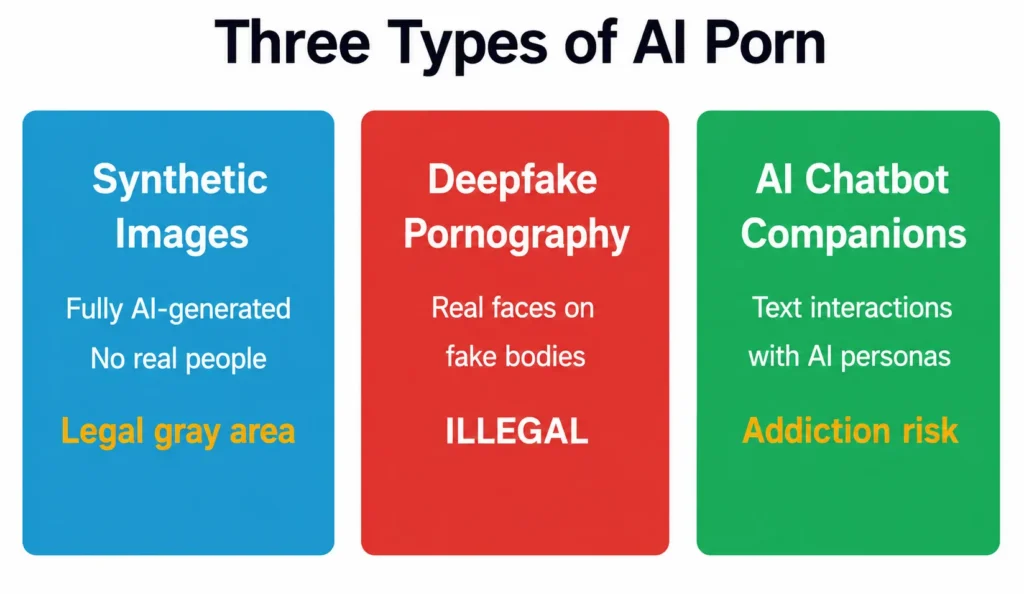
AI porn comes in several distinct forms, each with different legal and ethical implications.
Fully Synthetic AI-Generated Pornography
This is pornographic content created entirely by AI algorithms—no real people involved. Text-to-image generators like Stable Diffusion can produce explicit images from simple text prompts. These images depict people who don’t exist anywhere in the real world.
According to research from Harvard’s Misinformation Review, synthetic content prevalence on platforms like X peaked in March 2023 following the release of advanced image generation models. The rate later stabilized at around 0.2% of all community notes.
Interestingly, 77% of identified synthetic content on X is non-political and harmless, while 14% consists of deepfakes or audio of political figures.
Deepfake Pornography
This is where things get legally dangerous. Deepfake porn takes real people’s faces—often celebrities, ex-partners, classmates, or coworkers—and superimposes them onto pornographic videos or images.
The person appears to be engaging in sexual acts they never participated in. Their identity is stolen. Their likeness is weaponized.
Deepfake technology has become disturbingly accessible.
AI Porn Chatbots and Companions
These are conversational AI systems designed for sexual interaction. Users engage in explicit text conversations, sometimes paired with AI-generated images of fictional characters or personas.
Reports indicate that approximately 19% of U.S. adults have engaged with AI companions or chatbots. People are forming friendships and even romantic relationships with these systems, and when sexual content gets involved, the psychological impact intensifies.
A Simple Way to Explore AI Girlfriend

With Cherrypop.ai, you don’t need to set anything up. Just choose a companion or create your own and start interacting.
You can switch between different styles and see how each one feels in conversation.
Just Want to Try Something New?
Use Cherrypop.ai to:
- start chatting instantly
- test different companion styles
- adjust how characters respond
👉 Join free on Cherrypop.ai to try it yourself
Is Deepfake Pornography Illegal?
Yes. Creating or sharing deepfake pornography that uses someone’s likeness without consent is now a federal crime and illegal in most states.
Federal Law: The TAKE IT DOWN Act
Starting in the summer of 2026, victims can submit requests to websites and platforms to have their deepfake images removed. Website administrators must take down the image within 48 hours of receiving the request.
This option doesn’t require victims to know who the perpetrator is—a crucial protection since deepfake creators often remain anonymous.
Federal penalties for deepfake porn crimes include substantial fines and potential prison time. The law recognizes these offenses as serious violations of privacy and dignity.
State Deepfake Pornography Laws
Most states have enacted their own deepfake pornography statutes. Some criminalize creation, while nearly all criminalize distribution or threats to distribute.
Penalties vary by state but often include:
- Misdemeanor charges for first-time offenses
- Felony charges for repeat offenders or cases involving minors
- Fines ranging from thousands to tens of thousands of dollars
- Prison sentences from months to several years
- Mandatory registration requirements in some jurisdictions
The legal landscape continues evolving rapidly. What was a legal gray area three years ago now carries serious criminal consequences.
Why Deepfake Porn Crimes Are Difficult to Prosecute
Despite stronger laws, prosecution remains challenging for several reasons.
First, perpetrators often operate anonymously online, using VPNs, encrypted messaging, and pseudonymous accounts. Tracing the actual person behind the deepfake requires significant investigative resources.
Second, deepfakes cross jurisdictional boundaries. A creator in one state might target a victim in another state using servers in a third state. Which jurisdiction prosecutes? That’s not always clear.
Third, proving the content is actually a deepfake—and not consensual content the victim now regrets—sometimes requires expert forensic analysis. Defense attorneys will challenge the authenticity and the methodology used to detect manipulation.
How Deepfake Detection Actually Works
The arms race between deepfake creation and detection continues to escalate.
Academic research indicates rapid recent growth in deepfake detection papers, demonstrating how quickly this field is advancing.
Modern detection systems analyze multiple characteristics:
| Detection Method | What It Analyzes | Effectiveness |
|---|---|---|
| Pixel-level analysis | Compression artifacts, noise patterns, pixel inconsistencies | Moderate—can be fooled by advanced generators |
| Biological signals | Heartbeat visibility, breathing patterns, blinking consistency | High—difficult for AI to replicate perfectly |
| Physical inconsistencies | Lighting physics, reflection accuracy, shadow geometry | Very high—physics violations are hard to fake |
| Temporal analysis | Frame-to-frame consistency, motion fluidity | High—especially effective on video |
Advanced detection systems using large multimodal models have achieved near-perfect accuracy (99.8%) on certain datasets such as Wukong and SDv1.4 according to research on physical feature-based detection methods.
But here’s the problem. Detection accuracy varies dramatically depending on the generator used to create the fake. A detector trained on one AI model’s output might perform poorly on content from a different generator.
And as detection improves, so do the generators. It’s a technological cat-and-mouse game with no clear endpoint.
The Real Scope of the Problem
Just how big is the AI porn problem? Bigger than most people realize.
Security breaches related to manipulated media have risen by 67% according to recent analyses. These breaches include revenge porn, extortion schemes, harassment campaigns, and identity theft.
Look at the financial impact. In June 2024, the FTC filed suit against FBA Machine and Bratislav Rozenfeld, alleging they falsely guaranteed consumers could make money operating online storefronts using AI-powered software, defrauding consumers out of over significant amounts.
That’s just one case. The FTC has announced multiple crackdowns on deceptive AI claims and schemes, recognizing that AI hype creates opportunities for fraud and exploitation.
Who Gets Targeted?
Anyone can become a victim, but certain groups face disproportionate risk:
- Women and girls experience the overwhelming majority of non-consensual deepfake porn
- Public figures and celebrities find their likenesses stolen most frequently
- Ex-partners in abusive relationships face revenge porn threats
- Journalists and activists get targeted for intimidation
- Children and teenagers increasingly appear in synthetic sexual content
A notable example involves journalist Rana Ayyub, whose manipulated video went viral in 2018, causing severe personal and professional harm. Cases like this demonstrate the real-world damage deepfakes inflict.
AI Porn Addiction: A Growing Concern
While deepfake pornography creates obvious legal and ethical problems, fully synthetic AI porn raises different concerns—particularly around addiction and psychological harm.
AI porn addiction is considered a type of compulsive sexual behavior disorder, characterized by significant distress and impairment in daily functioning. The DSM-5 doesn’t include it as a formal diagnosis yet, but mental health professionals are increasingly encountering patients struggling with it.
Why AI Porn Is Particularly Addictive
Several factors make AI-generated pornography more addictive than traditional pornography.
First, infinite novelty. Traditional porn is limited by what real performers will do and what studios will produce. AI generators have no such limits. Users can create exactly what they want, whenever they want, in unlimited variations.
Second, personalization. Text-to-image generators allow users to specify every detail—body types, scenarios, settings, acts. This hyper-personalization creates stronger psychological hooks than generic content.
Third, accessibility. No paywall, no credit card, no human interaction required. Many AI porn generators are completely free and anonymous.
Fourth, escalation. Because AI can generate literally anything, users often escalate to increasingly extreme content that wouldn’t exist in traditional pornography. The dopamine-seeking behavior that drives addiction finds no natural ceiling.
Signs Someone Is Addicted to AI Porn
Common indicators include:
- Spending multiple hours daily generating or viewing AI pornography
- Neglecting work, school, or relationship responsibilities
- Inability to stop despite wanting to quit
- Escalating to more extreme or taboo content over time
- Preferring AI porn to real-world sexual relationships
- Experiencing withdrawal symptoms when unable to access it
- Hiding the behavior from partners or family members
Impact on Adolescents and Young Adults
The effects on developing brains are particularly concerning.
Adolescents exposed to AI pornography during critical developmental periods may form distorted views of sexuality, relationships, and consent. The unrealistic and often extreme nature of AI-generated content can shape expectations in harmful ways.
Young people also lack the critical thinking skills to recognize that AI porn depicts scenarios that are physically impossible, emotionally unhealthy, or legally problematic. They may attempt to recreate what they’ve seen, leading to dangerous situations.
Regulations and Legal Framework in 2026
The regulatory landscape has evolved significantly, though gaps remain.
The FTC has taken an aggressive stance on AI-related deception. In September 2024, the agency announced Operation AI Comply, including five law enforcement actions against operations using AI hype or selling AI technology for deceptive purposes.
In April 2025, the FTC ordered Workado to stop advertising its AI Content Detector as 98 percent accurate without maintaining competent and reliable evidence to support that claim. This set a precedent—AI companies must substantiate their performance claims.
Publishing.com paid $1.5 million in April 2026 to settle charges it misled consumers about income potential, demonstrating that AI-related business opportunity fraud carries real financial consequences.
The U.S. AI Safety Institute, part of NIST, has made mitigating risks from synthetic content a priority. Their frontier research focuses on developing technical standards and best practices for detecting and labeling AI-generated media.
| Year | Major Regulatory Action | Impact |
|---|---|---|
| 2024 | Operation AI Comply launched | Five enforcement actions; set precedent for AI fraud prosecution |
| 2025 | Workado FTC order | Required substantiation of AI detection accuracy claims |
| 2026 | TAKE IT DOWN Act provisions active | 48-hour mandatory removal of deepfake porn upon victim request |
| 2026 | Publishing.com settlement | $1.5M penalty for AI-related income misrepresentation |
What Victims Can Do
If you’ve been targeted with deepfake pornography, you have options.
Immediate Steps
Document everything. Take screenshots, save URLs, record when and where the content appeared. This evidence is crucial for both criminal prosecution and civil lawsuits.
Use the TAKE IT DOWN Act provisions. Submit removal requests directly to platforms. They must comply within 48 hours.
Report to law enforcement. File a police report, even if you don’t know the perpetrator’s identity. This creates an official record and may trigger an investigation.
Contact the platform directly. Most major platforms have dedicated teams for handling non-consensual intimate images, though response quality varies.
Civil Remedies
Victims can sue perpetrators for:
- Emotional distress
- Defamation
- Invasion of privacy
- Right of publicity violations
- Copyright infringement (if they used photos you own)
Monetary damages in successful lawsuits can be substantial, particularly when the victim can demonstrate professional, reputational, or psychological harm.
Support Resources
Organizations that help deepfake porn victims include:
- Cyber Civil Rights Initiative
- National Center for Missing & Exploited Children (for minors)
- FBI’s Internet Crime Complaint Center
- State victim advocacy organizations
- Mental health professionals specializing in technology-facilitated abuse
Frequently Asked Questions
Not reliably. Advanced AI-generated pornography can be photorealistic and virtually indistinguishable from real photos or videos to the human eye. Modern deepfakes have eliminated many tell-tale signs like unnatural blinking or distorted backgrounds. Detection requires specialized forensic tools that analyze pixel patterns, biological signals, and physics inconsistencies that aren’t visible through casual observation.
Creating AI pornography of yourself is generally legal since you’re using your own likeness with consent. However, distribution of such content may still have legal implications depending on where and how it’s shared. The critical legal line is consent—using your own face is legal, using someone else’s face without permission is not.
Complete removal is extremely difficult once content spreads across multiple platforms and jurisdictions. The TAKE IT DOWN Act requires platforms to remove content within 48 hours of a victim’s request, but this only applies to specific sites. Content may be re-uploaded by different users or continue existing on offshore servers beyond U.S. legal reach. Persistent monitoring and repeated takedown requests are often necessary.
Penalties vary significantly by jurisdiction. Federal charges can result in substantial prison time, particularly for cases involving minors or repeat offenses. State laws typically classify first-time deepfake porn creation as a misdemeanor with potential jail time of months to a year, while distribution or cases involving aggravating factors may constitute felonies with sentences of several years. The specific sentence depends on the jurisdiction, criminal history, and case circumstances.
AI sex chatbots carry psychological risks including addiction, social isolation, and distorted views of relationships and intimacy. Approximately 19% of U.S. adults have engaged with AI companions, and some users report forming intense emotional attachments that interfere with real-world relationships. The unlimited availability and personalization can create compulsive use patterns. For adolescents, exposure during developmental periods may shape unhealthy attitudes toward sexuality and consent.
Under the TAKE IT DOWN Act provisions active in 2026, platforms must remove deepfake pornography within 48 hours of receiving a victim’s removal request. This applies specifically to non-consensual intimate images using someone’s likeness without permission. Fully synthetic AI porn that doesn’t depict real people may not be covered by the same mandatory removal requirements, though platforms may remove it under their own content policies.
Yes, AI porn addiction is treatable through approaches used for other compulsive sexual behaviors and behavioral addictions. Treatment typically includes cognitive behavioral therapy, support groups, and addressing underlying psychological factors driving the compulsive use. Some individuals benefit from technology restrictions and accountability software. Mental health professionals are increasingly developing specialized treatment protocols for technology-facilitated sexual compulsions. Recovery is possible but requires commitment and often professional support.
The Technology Won’t Go Away
Here’s the hard truth. The technology for creating AI porn—both synthetic and deepfake—is now widely distributed and continuously improving.
Open-source AI models can’t be un-released. The knowledge of how to build these systems is permanently out there. New detection methods emerge, but so do new generation techniques that evade detection.
The solution isn’t purely technical. It requires a combination of:
- Strong legal frameworks with serious penalties
- Platform accountability and rapid response systems
- Public education about consent, authenticity, and digital literacy
- Continued investment in detection technology
- Mental health resources for those struggling with addiction or victimization
So is AI porn real? Absolutely. It exists in multiple forms, creates real victims, carries real legal consequences, and poses real psychological risks.
The question isn’t whether it’s real. The question is how we as a society will respond to it—through law, through technology, through education, and through fundamental respect for human dignity and consent.
Leave a Reply